
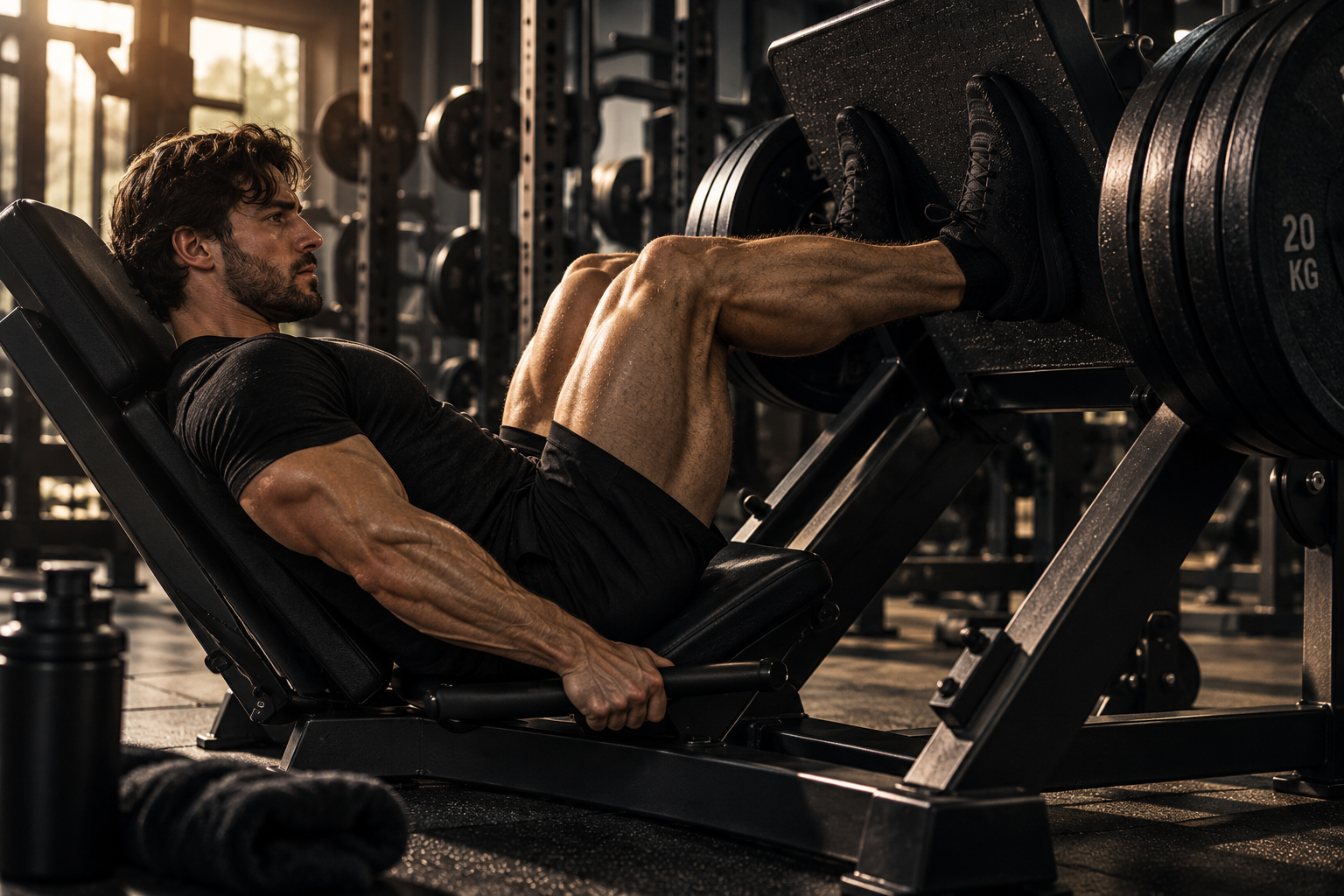
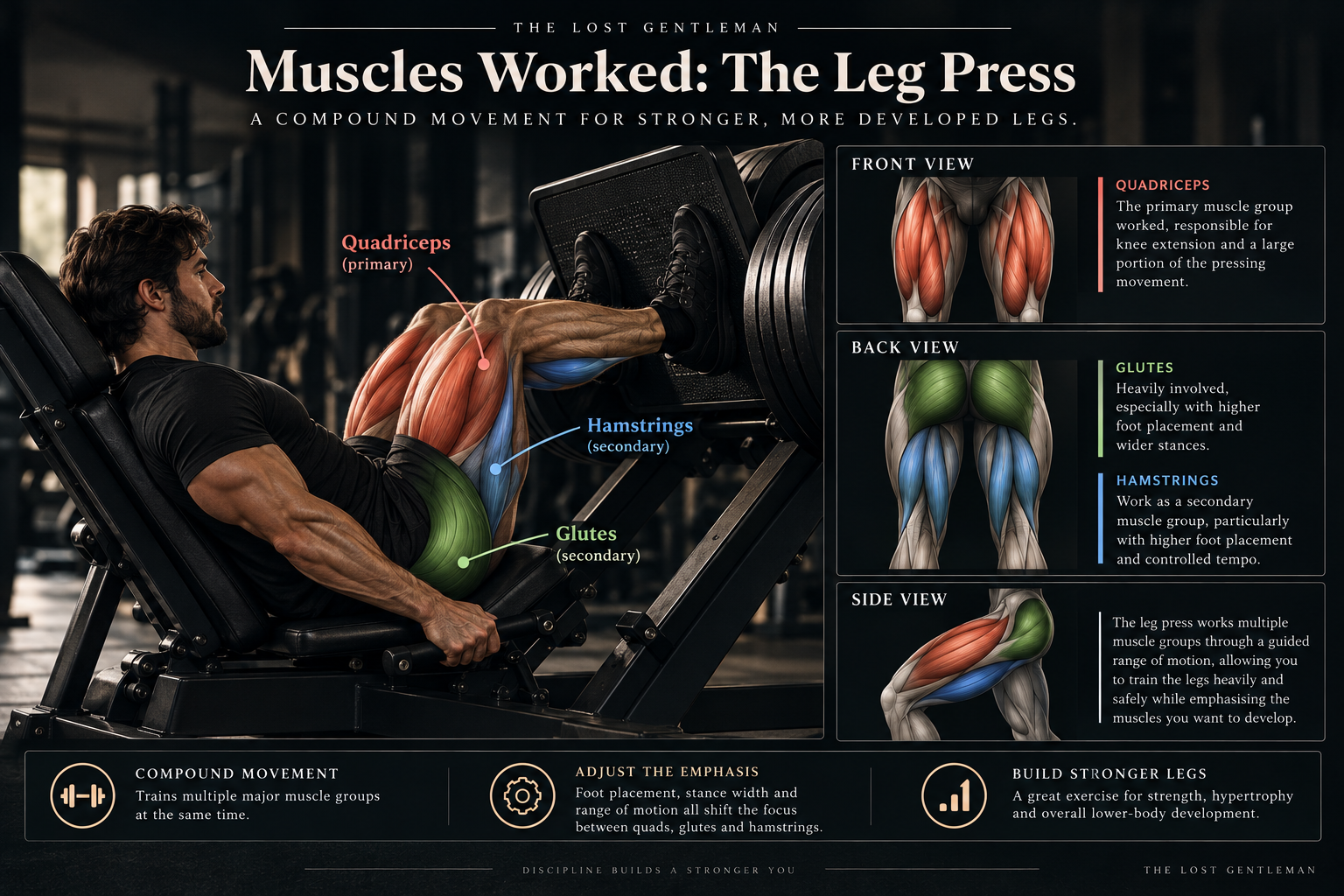
The leg press is one of the most reliable machine-based exercises for building strength and size across the quadriceps, hamstrings, and glutes. Its guided, fixed movement path makes it considerably more forgiving on technique than a free-weight squat, which is exactly why it’s often recommended as a safer starting point for newer lifters — without sacrificing the ability to load the legs heavily as you progress.
Warming Up
Before loading the leg press with any significant weight, spend 5-10 minutes warming up the hips, knees, and ankles. Light cardio — cycling or a brisk walk on an incline — raises blood flow to the legs, while dynamic movements such as bodyweight squats, leg swings, and walking lunges prepare the joints for the range of motion the leg press demands. Follow this with one or two light warm-up sets on the machine itself, well below your working weight, to groove the movement pattern before adding load.
Equipment and Setup
Leg press machines come in two common types: the angled “sled” style, where you push a weighted sled upward along rails, and the seated horizontal style, where you push a plate forward against a cable-driven weight stack. Both work the same muscles, though the sled version tends to allow heavier loading.
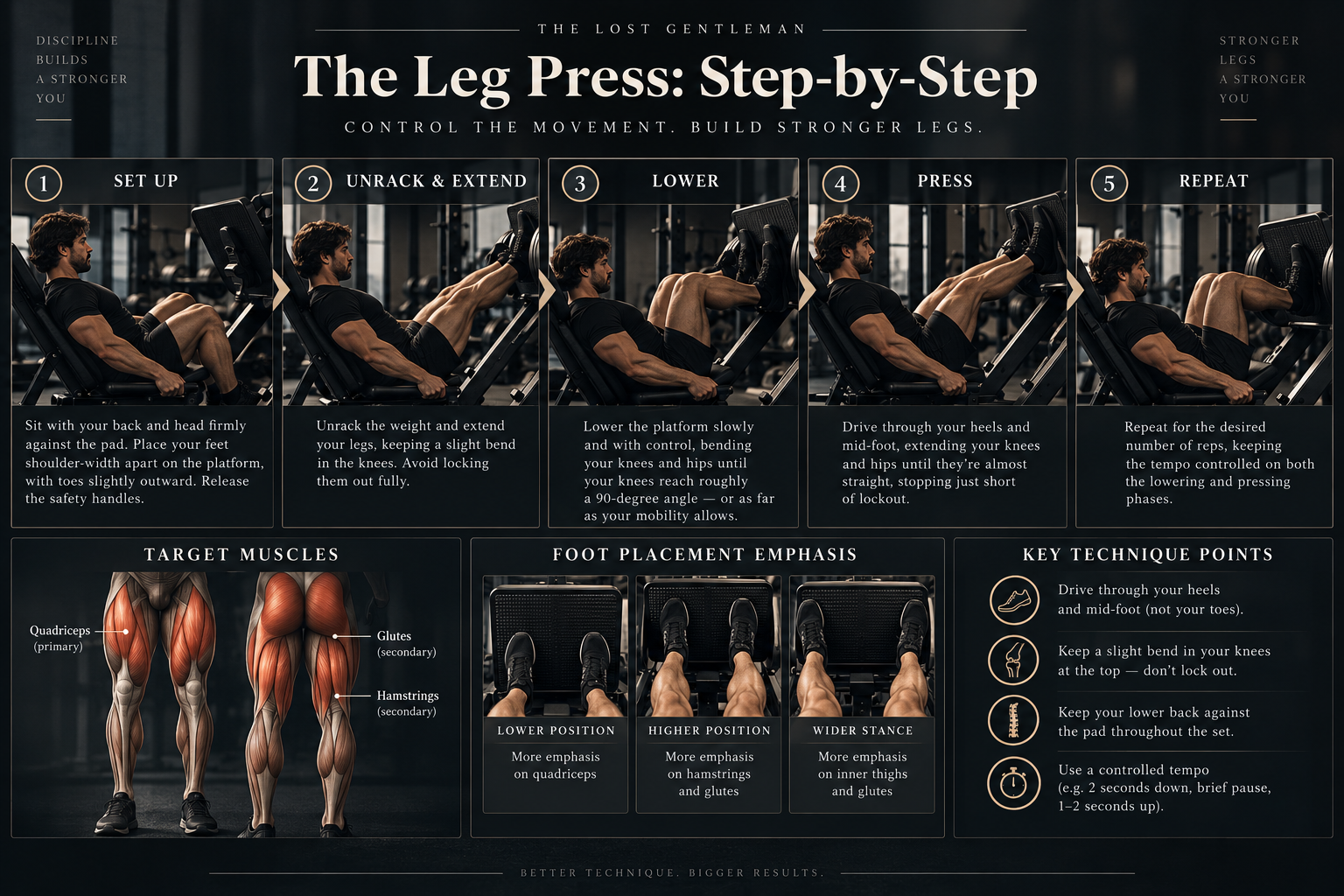
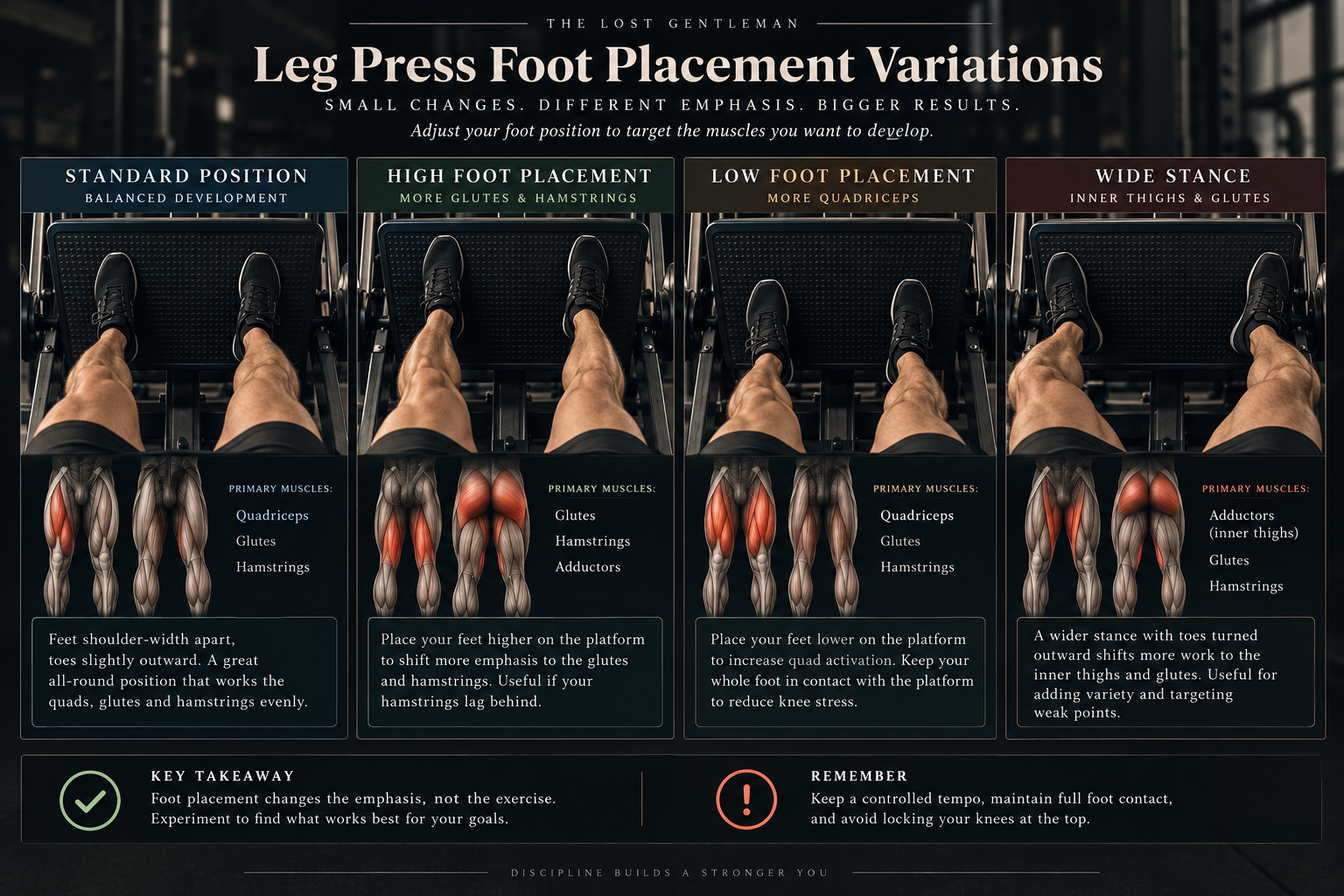
Sit in the machine with your back and head firmly against the padded support. Place your feet on the platform at roughly shoulder-width apart, with toes pointed slightly outward. Foot position on the platform changes the emphasis of the exercise slightly: feet placed higher on the platform shift more work to the glutes and hamstrings, while feet placed lower emphasise the quadriceps more directly. A narrower stance tends to bias the outer quadriceps, while a wider stance shifts more work to the inner thigh and glutes.
Performing the Movement
- Release the safety handles and extend your legs to unrack the weight, keeping a slight bend in the knees rather than locking them out fully.
- Lower the platform slowly and with control by bending your knees and hips, allowing the weight to travel down towards your chest.
- Continue lowering until your knees reach roughly a 90-degree angle — or as far as your mobility comfortably allows without your lower back rounding off the pad.
- Press back up by driving through your heels and mid-foot, extending your knees and hips until they’re almost fully straight, stopping just short of locking out.
- Repeat for the desired number of reps, keeping the tempo controlled on both the lowering and pressing phases.

Variations
Single-leg press — performing the movement one leg at a time removes any compensation from a stronger side, and is a useful way to address a strength imbalance between your legs.
Wide-stance leg press — feet placed wide and turned outward shifts more emphasis onto the inner thighs and glutes, complementing a standard-stance session.
High foot placement — positioning the feet higher on the platform emphasises the hamstrings and glutes more than a standard mid-platform stance, useful if your hamstrings lag behind your quadriceps.
Rep Ranges by Goal
- Strength: 3-5 sets of 4-6 reps at a heavy weight, resting 2-3 minutes between sets to allow full recovery.
- Hypertrophy: 3-4 sets of 8-12 reps at a moderate-to-challenging weight, resting 1-2 minutes between sets.
- Endurance: 2-3 sets of 15-20 reps at a lighter weight, resting 30-60 seconds between sets.
These ranges follow the same general model covered in our guide to choosing the right rep range for your goal — heavier loads for lower reps prioritise strength adaptation, moderate loads taken close to fatigue drive hypertrophy, and lighter loads for higher reps build muscular endurance.
Mind-Muscle Connection and Technique
Moving the weight correctly is only part of the leg press — how deliberately you feel the target muscles working matters just as much, particularly for hypertrophy. On the leg press specifically, consciously drive through your heel and mid-foot rather than your toes; over-reliance on the toes shifts emphasis onto the calves and reduces the tension actually placed on the quadriceps and glutes. At the top of each rep, pause briefly and squeeze the quads deliberately, rather than simply letting the sled reach the top and immediately reversing direction.
Breathing also plays a role in both control and connection to the movement: inhale as you lower the platform, and exhale as you press it away. Controlling your tempo — for example, a 2-second lowering phase, a brief pause, and a controlled 1-2 second press — reinforces the same time-under-tension principle that applies across resistance training more broadly, and gives you more opportunity to actually feel the muscle working through the full range.
It’s worth being honest about weight selection here too. Loading the leg press with more than you can control well doesn’t just risk poor form — it also means your stabilising muscles, joints, and momentum start doing more of the work, at the direct expense of tension on the quadriceps, hamstrings, and glutes themselves. This isn’t an argument against training heavy — progressively increasing load is central to long-term growth — but it is worth setting your ego aside, particularly as a beginner. Starting with a genuinely light weight, focusing entirely on a full range of motion and a deliberate squeeze at the top, teaches your body what the target muscles are actually meant to feel like under load. That awareness carries over and improves the quality of every heavier set that follows as you progress.
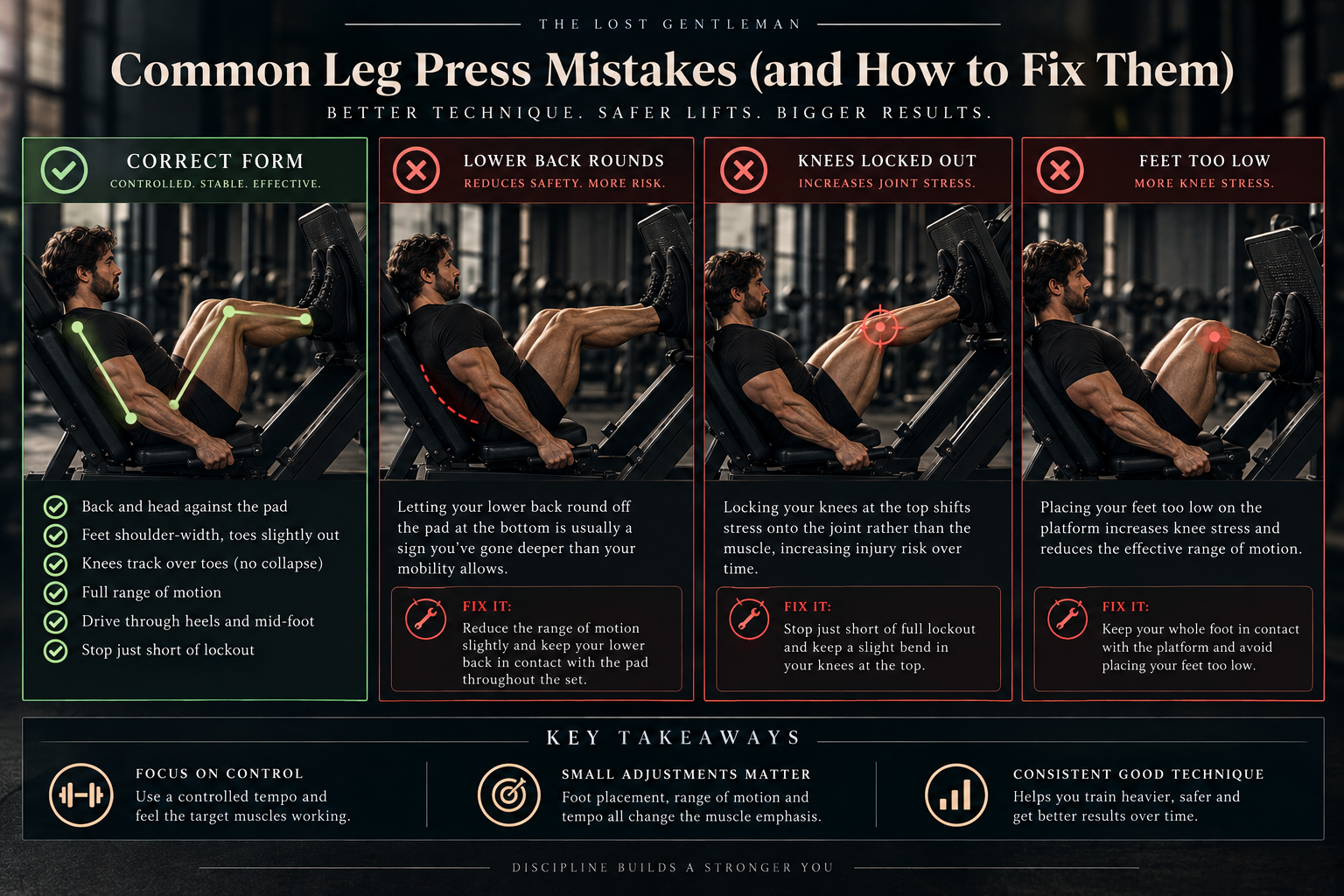
This shifts stress onto the joint itself rather than the muscle, and increases injury risk over repeated sets — always stop just short of full lockout.
Letting the lower back round off the pad at the bottom of the movement. This is usually a sign you’ve gone deeper than your hip and hamstring flexibility comfortably allows. Reducing the range of motion slightly is safer than forcing extra depth at the cost of a rounded spine.
Placing feet too low on the platform. This increases knee stress and reduces the effective range of motion — keep your whole foot in contact with the platform throughout the set.
Using excessive weight to compensate for poor range of motion. The leg press can handle heavy loads, which makes it easy to sacrifice depth and control for a bigger number — the muscle benefits far more from full, controlled reps than partial ones with more plates loaded.
Placing feet too close together or too high. This unnecessarily loads the knee joint and reduces glute and hamstring involvement — keep foot placement deliberate rather than default to whatever feels easiest to load heavy.
Programming the Leg Press
If you’re building a leg session around it, the leg press pairs naturally with the barbell squat and the deadlift as one of the primary compound movements in a lower-body routine, with isolation work such as leg curls and leg extensions added afterwards to target the hamstrings and quadriceps more directly.
As with any compound lower-body lift, applying progressive overload over time — through added weight, added reps, or a controlled tempo — is what actually turns the leg press into a long-term muscle-building tool rather than just a safe alternative to squatting.
Leave a Reply