
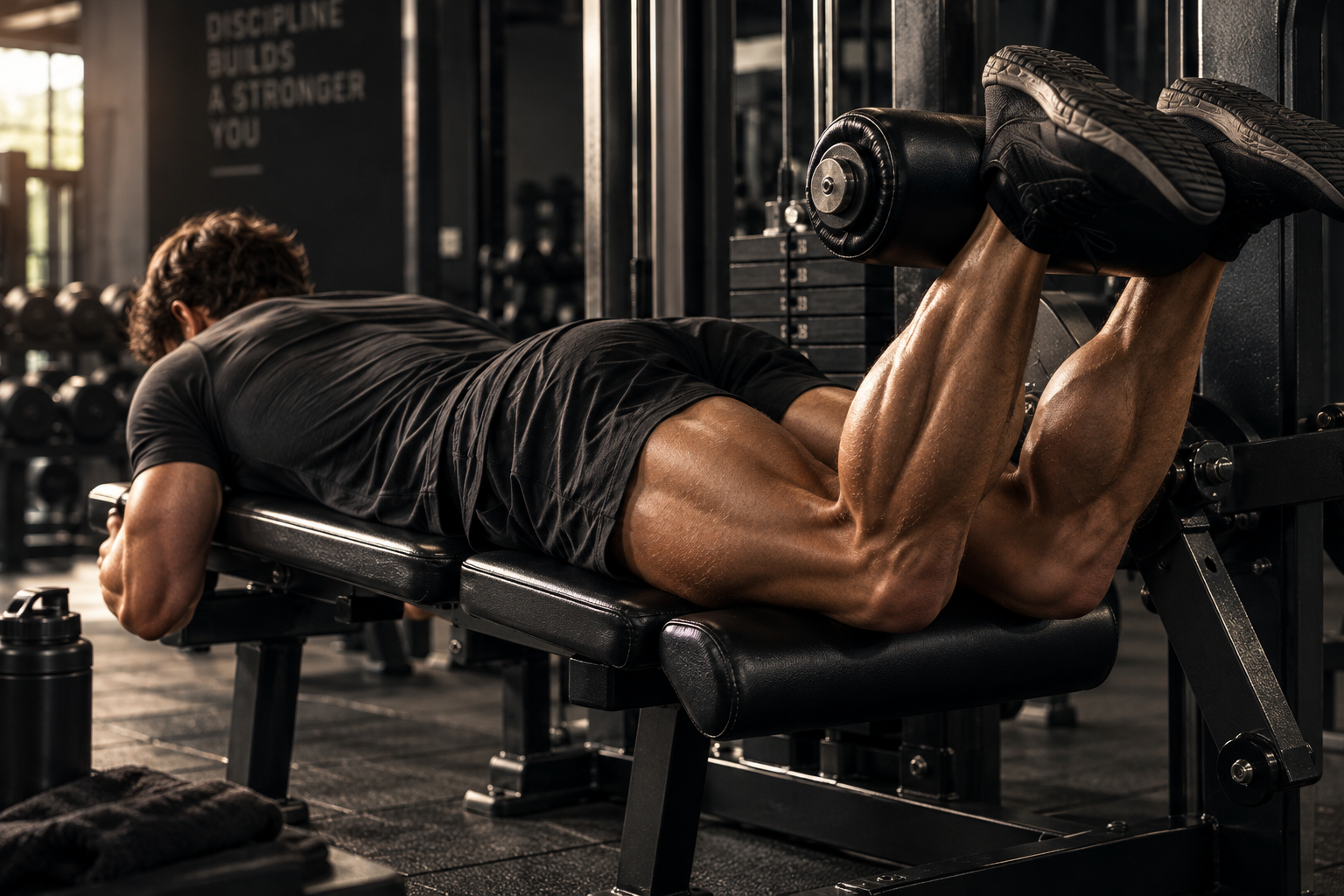
The leg curl is an isolation exercise that targets the hamstrings directly — the group of muscles running along the back of the thigh, made up of the semimembranosus, semitendinosus, and biceps femoris. Unlike compound lower-body lifts such as the squat or deadlift, which involve several muscle groups working together, the leg curl isolates the hamstrings almost entirely, making it a useful addition for balancing out a leg-training programme that’s otherwise dominated by quad-focused compound movements.
Warming Up
Because the leg curl is an isolation movement, a shorter warm-up is generally sufficient compared to a heavy compound lift. A few minutes of light cardio to raise blood flow, followed by one light set on the machine itself at a low weight, is usually enough to prepare the hamstrings for working sets. If your hamstrings tend to feel tight, a few dynamic leg swings beforehand can help.
Equipment and Setup
Leg curls can be performed lying, seated, or standing, depending on the machine available — all three train the same muscle group, with subtle differences in emphasis and comfort.
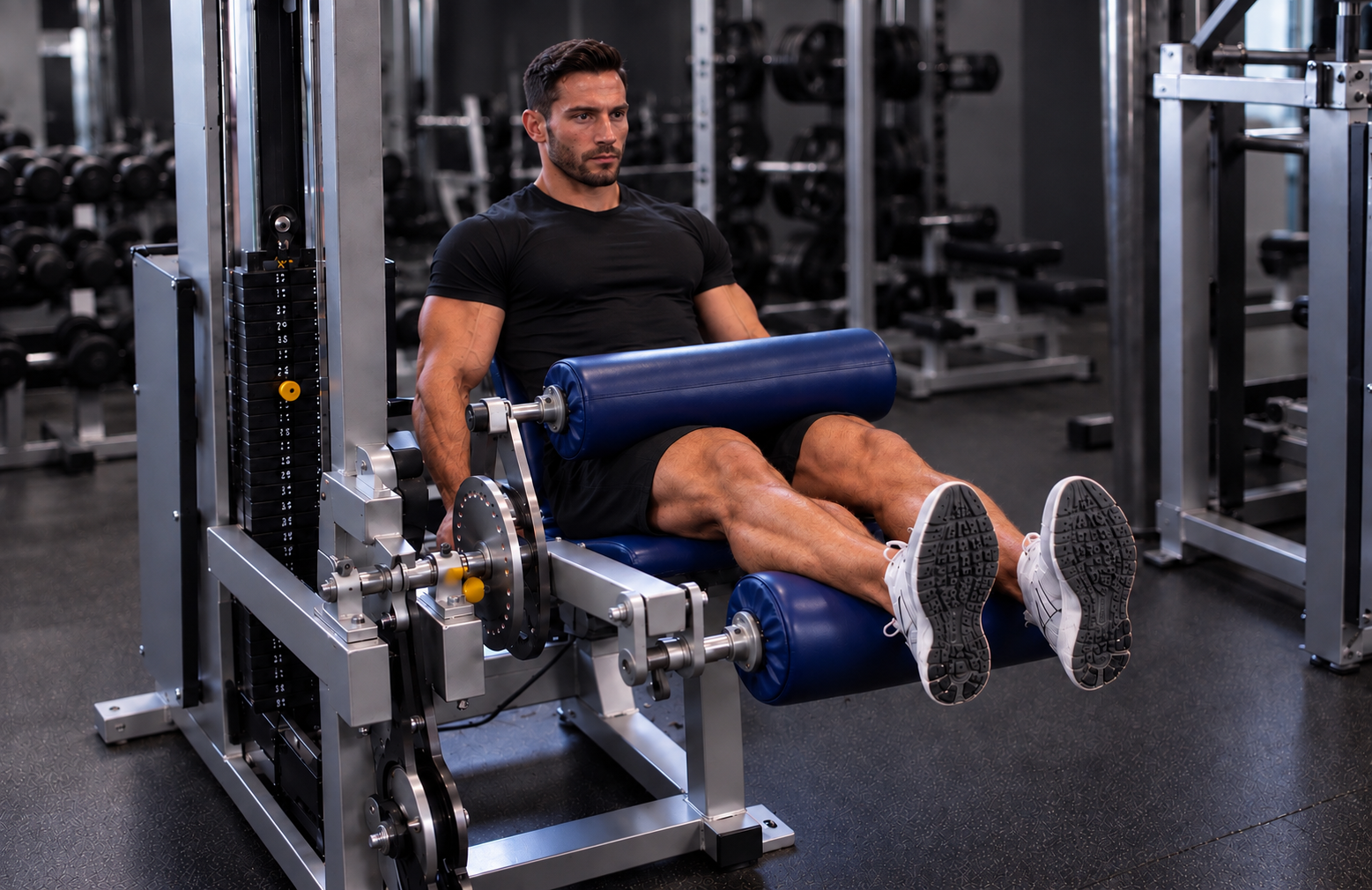
For the lying leg curl, position yourself face down on the bench with the padded lever resting just above your heels, and your knees aligned with the machine’s pivot point. For the seated leg curl, sit with your back against the pad and the lever positioned across the back of your lower legs, just above the ankles — this variation tends to feel more stable for beginners. The standing leg curl, performed one leg at a time, demands more balance but allows a very deliberate, focused contraction on each side individually.
How to Perform the Leg Curl Properly
Although the leg curl is relatively simple to perform, good technique makes a considerable difference to how effectively you train your hamstrings. The aim is to bend your knees against resistance while keeping your hips and torso stable, allowing the hamstrings to perform the movement without relying on momentum.
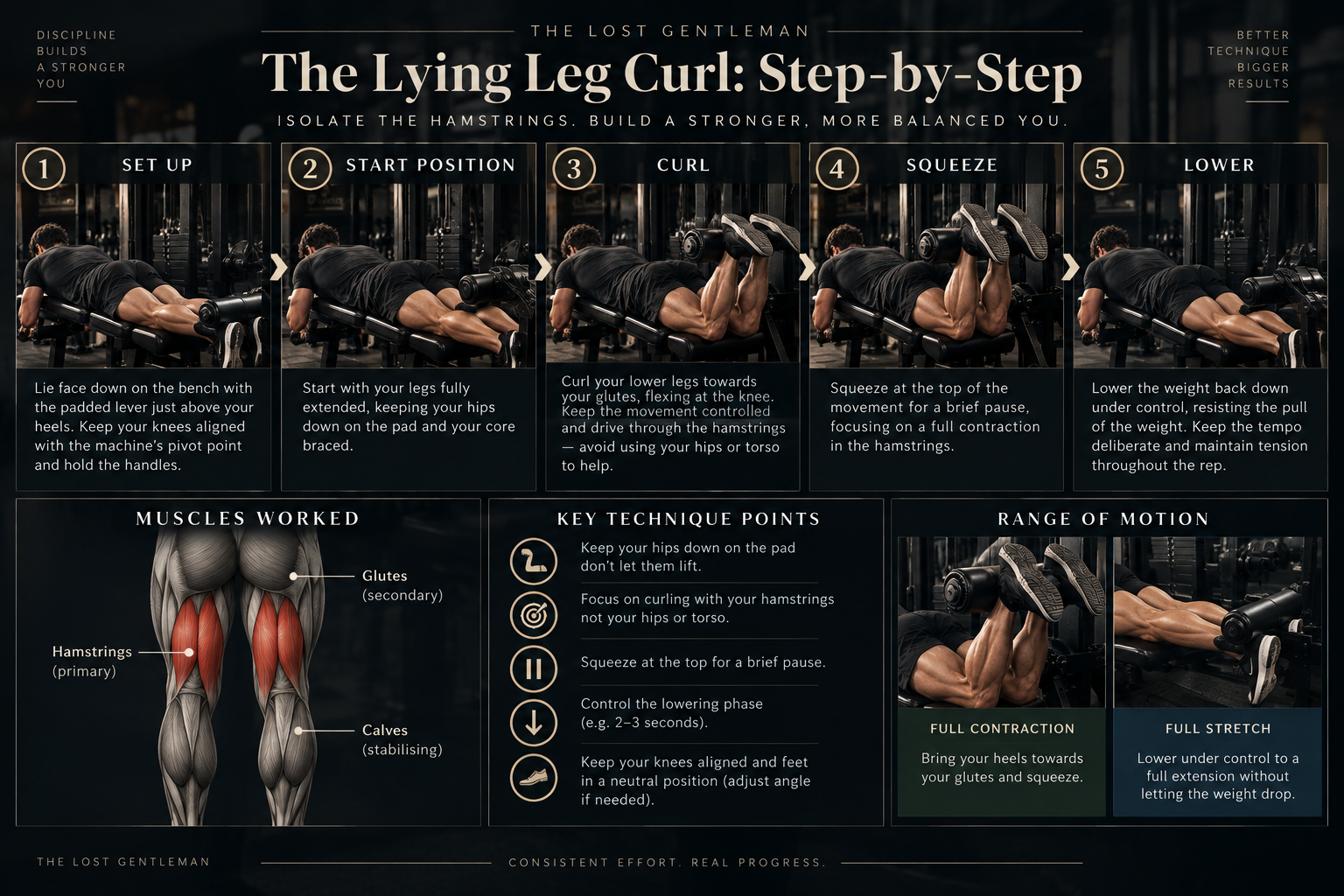
Follow these steps to get the most from each repetition:
- Start with a manageable weight. If you’re new to leg curls, select a relatively light resistance that allows you to complete 10–15 repetitions with good technique. There’s no need to lift heavily while learning the movement. A lighter weight makes it easier to control the exercise and recognise when your hamstrings are doing the work.
- Adjust the machine to fit your body. Position your knees in line with the machine’s pivot point and ensure the lower-leg pad rests comfortably just above your heels, near the back of your ankles. On a seated leg curl, adjust the thigh pad so your legs are held securely without excessive pressure. On a lying leg curl, position yourself face down with your knees close to the edge of the bench, according to the machine’s design.
- Keep your hips and torso stable. This is particularly important during lying leg curls. Gently brace your abdominal muscles and press your hips and pelvis into the bench throughout the movement. This helps prevent your hips from lifting and your lower back from arching as the weight becomes challenging. On a seated machine, keep your hips against the seat and your back supported by the backrest. Avoid lifting your hips or leaning forwards to assist the movement.
- Curl your legs towards your glutes. Begin bending your knees by contracting your hamstrings. On a lying machine, imagine drawing your heels towards your backside. On a seated machine, pull your lower legs down and backwards beneath the seat. Keep the movement smooth and avoid using your hips or torso to generate momentum.
- Squeeze your hamstrings at the peak contraction. As your knees reach their most flexed comfortable position, deliberately contract your hamstrings and pause briefly. Holding this position for approximately one second can help improve muscular awareness and ensure you’re not simply moving the weight. Occasionally extending the pause to two or three seconds can make lighter sets more challenging and increase time under tension.
- Lower the weight slowly and under control. Rather than allowing the weight stack to pull your legs back towards the starting position, resist it throughout the return. Aim for approximately two to three seconds during the lowering phase. This controlled eccentric movement maintains tension on the hamstrings and prevents the weight from dropping or slamming.
- Return to a comfortable extended position. Allow your knees to straighten until your hamstrings reach a comfortable stretch, without forcing the joint into hyperextension. Keep your hips stable and avoid relaxing completely between repetitions.
- Repeat with a consistent tempo. Aim for approximately one to two seconds during the curl, a brief squeeze at the top and two to three seconds during the lowering phase. Every repetition should look similar. If you begin swinging your legs, lifting your hips or losing control, reduce the weight.

Why Hip Position Matters During Leg Curls
Keeping the pelvis stable is particularly important during the lying leg curl.
When the resistance becomes too heavy, some lifters instinctively lift their hips away from the bench and arch their lower back to help move the weight. This changes the movement and introduces unnecessary compensation through the torso.
To prevent this, think about pressing your hips gently down into the pad while keeping your abdominal muscles engaged. Your pelvis should remain supported throughout the repetition, allowing the movement to come primarily from bending the knees.
The seated leg curl is slightly different. Because your hips are already flexed and your back is supported, the machine helps maintain your position. However, you should still keep your backside against the seat and avoid lifting your hips or rocking forwards as you curl.
Research has also shown that seated leg curls can be particularly effective for hamstring development because the hip-flexed position places several of the hamstring muscles at a longer starting length.
Rest Periods and Repetitions
For beginners, a sensible starting point is:
- Sets: 2–3
- Repetitions: 10–15
- Rest: 60–90 seconds between sets
- Tempo: 1–2 seconds curling, a brief pause, and 2–3 seconds lowering
Choose a weight that makes the final few repetitions challenging while still allowing good control.
As your strength improves, you can gradually increase the resistance. However, avoid sacrificing your range of motion, hip stability or controlled tempo simply to lift more weight.
The most effective leg curls are rarely the ones performed with the heaviest weight stack. They’re the ones where your hamstrings remain responsible for the movement from the first repetition to the last.
Leg Curl Variations
Standing single-leg curl — trains each leg independently, useful for correcting a strength imbalance between your hamstrings, and demands more stabiliser engagement than the lying or seated versions.
Seated leg curl with toes pointed inward or outward — subtly shifting foot rotation slightly changes which portion of the hamstring is emphasised, though the difference is minor compared to changing the exercise itself.
Slow-eccentric leg curl — deliberately slowing the lowering phase (for example, a 4-second lowering count) increases time-under-tension and is a useful technique once you’ve mastered the standard tempo.
Rep Ranges by Goal
- Strength/hamstring stability focus: 3-4 sets of 6-8 reps at a challenging weight, resting 1.5-2 minutes between sets.
- Hypertrophy: 3-4 sets of 10-15 reps at a moderate weight, resting 60-90 seconds between sets.
- Endurance: 2-3 sets of 15-20+ reps at a lighter weight, resting 30-45 seconds between sets.
As an isolation exercise, the leg curl is rarely trained in a true low-rep strength range the way a compound lift is — moderate-to-higher reps generally suit it better, in line with the broader principles in our guide to choosing the right rep range for your goal.
Mind-Muscle Connection and Technique
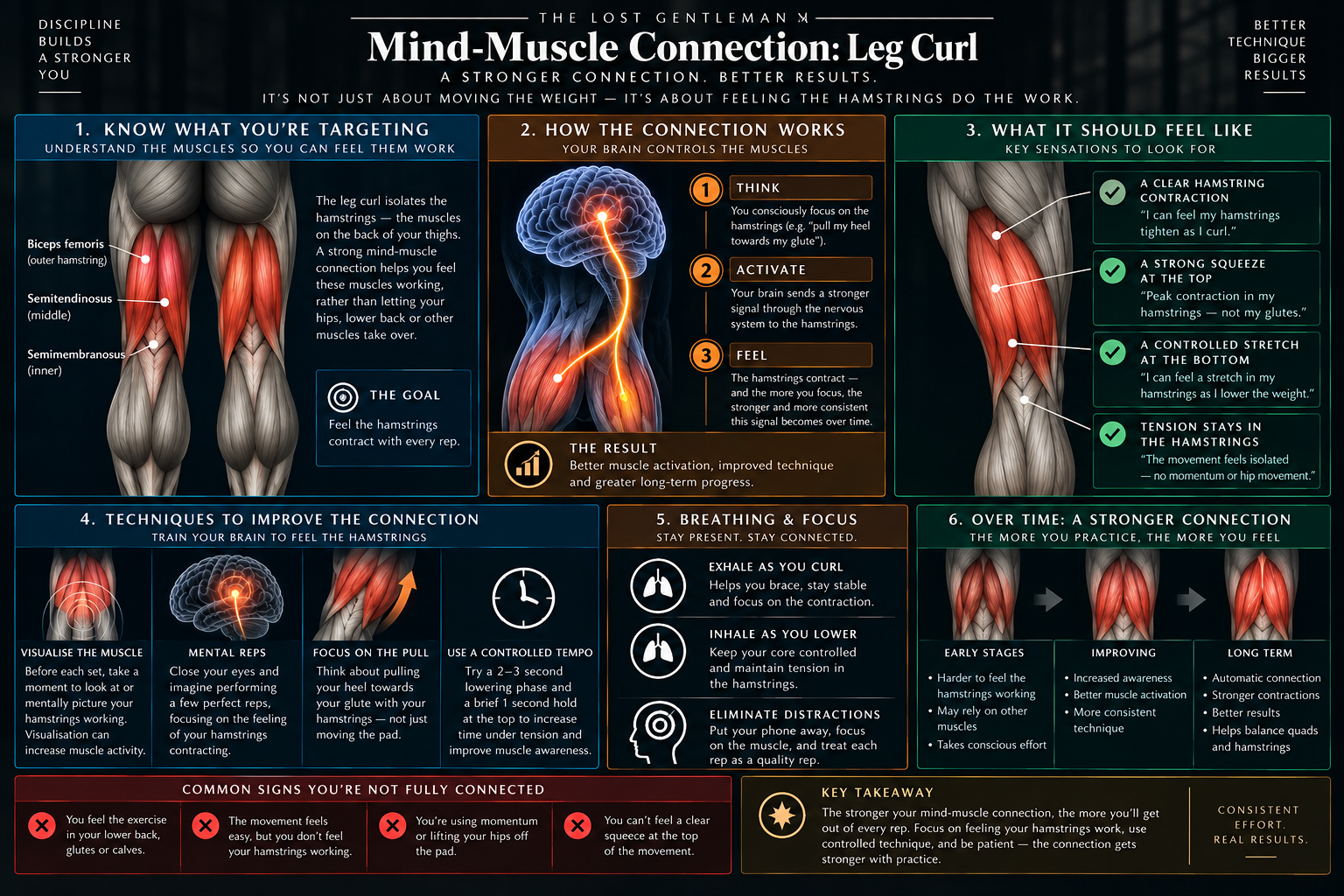
The leg curl is one of the clearer examples of why mind-muscle connection matters as much as the movement itself. Rather than simply moving the lever from A to B, focus specifically on the feeling of pulling your heel towards your glute — mentally driving the contraction through the hamstring, rather than letting the machine’s fixed path do the work for you. At the top of each rep, hold a deliberate squeeze for a full second before lowering, giving the hamstring a genuine peak contraction to work against rather than rushing straight back down.
Breathing follows the same pattern as most resistance exercises: exhale as you curl the weight up, inhale as you lower it back down. A controlled tempo — for example, a 1-2 second curl, a brief hold at the top, and a slower 2-3 second lowering phase — reinforces exactly the kind of time-under-tension that makes isolation exercises like this one so effective when done properly.
Weight selection matters more here than it might seem. Loading the leg curl too heavy makes it very easy for the hips to lift off the pad or for momentum to take over the lift — at which point stabilising muscles and momentum are doing much of the work that the hamstrings should be doing. This doesn’t mean you should avoid progressing to heavier loads over time — you should, and progression matters — but especially as a beginner, it’s worth starting genuinely light, setting ego aside, and learning to squeeze and hold at peak contraction with full control. Once that connection is established, adding weight builds on a foundation that actually targets the hamstrings, rather than working around them.
This is the most common leg curl mistake — jerking the weight upward using hip movement or torso momentum removes tension from the hamstring and increases injury risk. The movement should come entirely from the knee joint.
Lifting the hips off the pad during the lying variation. This is often a sign the weight is too heavy to control with proper form — reduce the load and prioritise a full, controlled range of motion.
Only performing a partial range of motion. A leg curl performed through a shortened range trains a much smaller portion of the hamstring’s full capacity — aim for a full contraction at the top and a full stretch at the bottom of each rep.
Rushing the eccentric (lowering) phase. Letting the weight drop back down under gravity wastes a significant portion of the exercise’s benefit — control the descent just as deliberately as the curl itself.
Programming the Leg Curl
Leg curls work well as an isolation finisher after compound lower-body lifts such as the barbell squat, deadlift, or leg press, where the bigger lifts have already fatigued the legs and a targeted isolation movement finishes off the hamstrings specifically, in line with general isolation exercise principles.
Because it’s one of the few exercises that directly isolates the hamstrings, the leg curl is also a useful tool for correcting muscular imbalances between the quadriceps and hamstrings — something worth paying attention to if you notice one growing noticeably faster than the other over time.
Leave a Reply