

For years, the traditional approach to building muscle has followed a predictable cycle: bulk, then cut.
Eat in a large calorie surplus, gain as much size as possible — along with a fair amount of fat — then spend months dieting it off. Repeat the process, year after year.
But more recently, a different approach has gained traction. One that prioritises control over extremes.
It is known as maingaining.
And for many, it offers a more sustainable, precise way to build muscle without the unnecessary weight gain that often comes with traditional bulking.
What is Maingaining?
Maingaining refers to the process of building muscle while maintaining (or very slowly increasing) body weight.
Rather than eating in a large calorie surplus, maingaining typically involves:
- Eating at or slightly above maintenance calories
- Training consistently with progressive overload
- Prioritising a high protein intake
The goal is straightforward: maximise muscle growth while minimising fat gain. In practice, this means slower, more controlled progress — but with far less need to “undo” excess fat gain later.


Where Did Maingaining Come From?
The concept has been popularised in recent years within evidence-based fitness circles and aligns closely with what research refers to as body recomposition.
While not new from a scientific standpoint, the shift is largely philosophical. Instead of chasing rapid scale weight increases, the focus moves towards improving body composition gradually — building muscle while keeping fat gain tightly controlled.
How Maingaining Works
Muscle growth is driven by three key factors:
- Resistance training (the stimulus)
- Protein intake (the building material)
- Sufficient energy (the support system)
Traditional bulking tends to push the third variable — calories — well beyond what is necessary. Maingaining, by contrast, takes a more measured approach. It provides just enough energy to support growth, while relying on training quality and consistency to do the heavy lifting.
Research shows that muscle can be built at maintenance or within a small surplus, particularly in beginners and intermediate lifters (Phillips & Van Loon, 2011). This is the principle maingaining is built on.
Calorie Intake for Maingaining
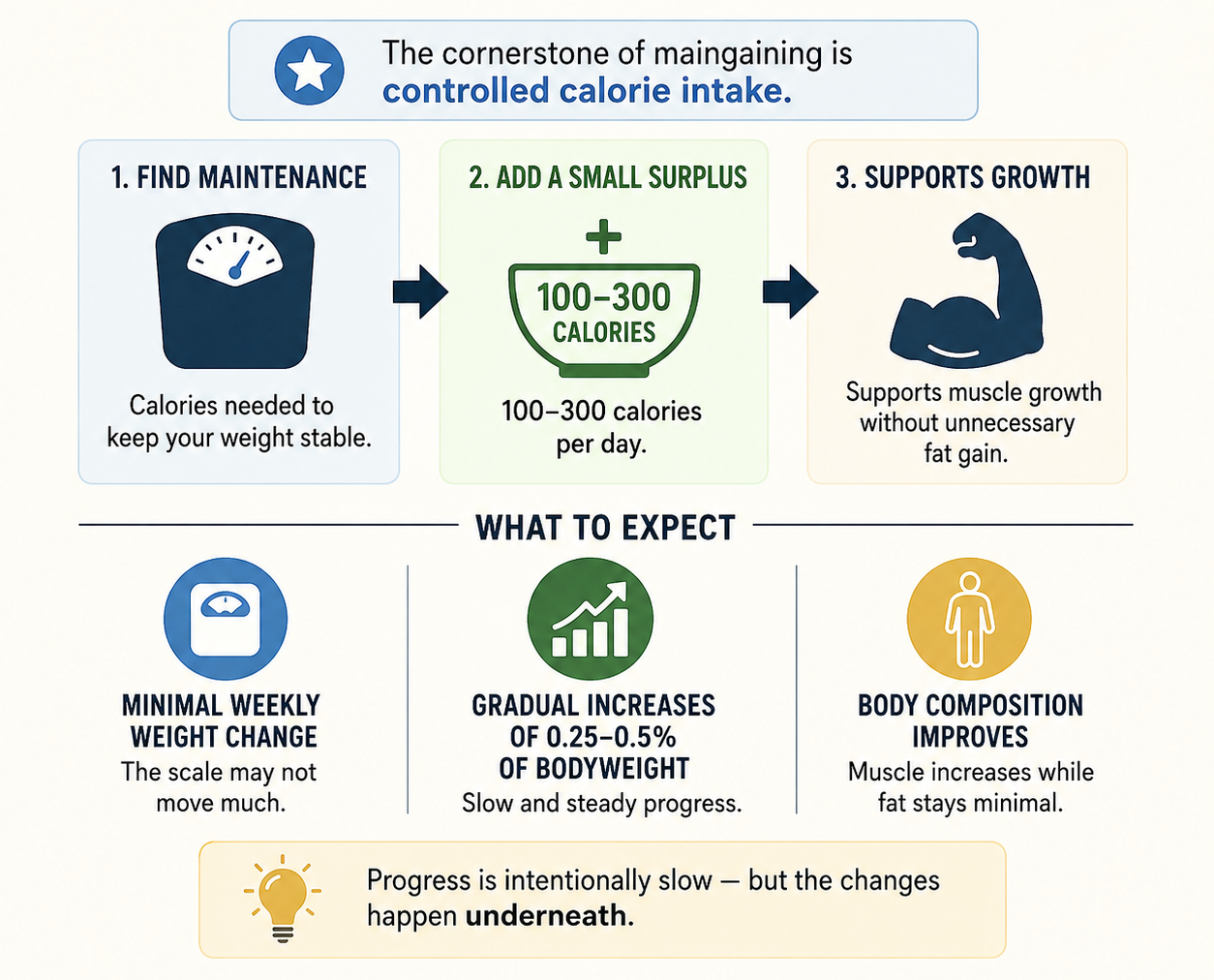
The cornerstone of maingaining is controlled calorie intake.
Start by establishing your maintenance calories — the number required to keep your weight stable. From there, introduce a small surplus of around:
- 100–300 calories per day
This is enough to support muscle growth without encouraging unnecessary fat gain.
Progress is intentionally slow. You may see:
- Minimal weekly weight change
- Or gradual increases of around 0.25–0.5% of bodyweight
In some cases, the scale may not move much at all — but body composition improves underneath.
Macronutrients for Maingaining
Getting your macronutrients right is where maingaining becomes effective rather than guesswork.
Protein is the priority, supporting muscle repair and growth. A daily intake of:
- 1.6–2.2g per kg of bodyweight
…is widely supported in the literature (Morton et al., 2018).
Carbohydrates should make up a significant portion of your intake, particularly if you are training regularly. They fuel performance and recovery, with a general guideline of:
- 3–5g per kg of bodyweight
Fats round things out, supporting hormonal health and overall function:
- 20–30% of total calorie intake
The key here is balance — not extremes.
The Benefits of Maingaining
One of the biggest advantages of maingaining is how controlled it is.
By avoiding large calorie surpluses, fat gain is kept to a minimum. This means you can maintain a relatively lean physique year-round, rather than cycling between extremes.
There are several practical benefits to this approach:
- Less need for long, aggressive cutting phases
- More consistent energy levels in training
- Improved long-term dietary habits
- A steady, sustainable rate of progress
It also encourages a more disciplined approach to nutrition. Rather than eating excessively “because you’re bulking,” you learn to eat with intent — adjusting intake based on actual needs.
The Drawbacks of Maingaining
As with any approach, there are trade-offs.
The most obvious is the slower rate of muscle gain. Without a large calorie surplus, growth is more gradual — particularly for those who are already well-trained.
There are a few key limitations to be aware of:
- Progress can feel slow and less noticeable in the short term
- Calorie intake needs to be monitored more closely
- Small errors (under- or overeating) have a greater impact
For some, this level of precision can feel restrictive. Others may simply prefer the faster (albeit less controlled) results of a traditional bulk.
It is also worth noting that maingaining is not ideal for everyone. Those who are underweight or looking to gain significant mass quickly may benefit more from a larger calorie surplus.
Training for Maingaining
Maingaining only works if your training supports it.
Because calorie intake is controlled, you cannot rely on excess energy to drive progress. Instead, your training must be consistent and progressive.
This typically involves:
- Applying progressive overload (increasing weight, reps, or volume over time)
- Training each muscle group 2–3 times per week
- Maintaining sufficient weekly volume (around 10–20 sets per muscle group)
- Training close to failure (1–3 reps in reserve)
Without this level of intent, maingaining becomes maintenance rather than growth.

Who Should Use Maingaining?
Maingaining is particularly effective for:
- Beginners and intermediate lifters
- Those who want to stay relatively lean year-round
- Individuals who dislike bulk-and-cut cycles
It suits those who value consistency and long-term progress over rapid, short-term changes.
However, it may be less suitable for:
- Very underweight individuals
- Advanced lifters chasing maximum size gain
Tracking Progress
Because progress is gradual, tracking becomes essential.
Rather than relying solely on the scale, use a combination of:
- Bodyweight trends (weekly averages)
- Progress photos
- Strength improvements
- Body measurements
This gives a more accurate picture of what is actually changing.
Maingaining May Help You to Reach Your Goals!
Maingaining represents a more refined approach to building muscle.
It moves away from extremes and towards control — focusing on steady, sustainable progress rather than rapid fluctuations in weight.
It is not the fastest method. But for many, it is the most practical.
Train consistently. Eat with intention. Track your progress.