

Strength is often mistaken for something simple — a product of effort, repetition, and discipline. And while those elements matter, they are merely the visible surface of something far more intricate.
Every time you lift a weight, sprint for a train, or even adjust your posture, a highly coordinated biological process unfolds beneath the skin. Muscles do not simply “contract” on command. They respond to electrical signals, chemical reactions, and microscopic interactions that occur in fractions of a second.
Understanding the science behind muscle contraction will not turn you into a physiologist overnight. But it will change how you train — and more importantly, how you think about training.
Because once you understand what is actually happening inside the muscle, your approach becomes more deliberate, more precise, and ultimately, more effective.
Muscle Structure: More Than Meets the Eye
Before we examine contraction, we must first understand the structure of muscle itself.
Skeletal muscle — the type responsible for movement and strength — is organised in layers:
- Muscle fibres (individual muscle cells)
- Myofibrils (threads within each fibre)
- Sarcomeres (the fundamental contractile units)
It is within the sarcomere that the real work takes place.
Each sarcomere contains two key protein filaments:
- Actin (thin filaments)
- Myosin (thick filaments)

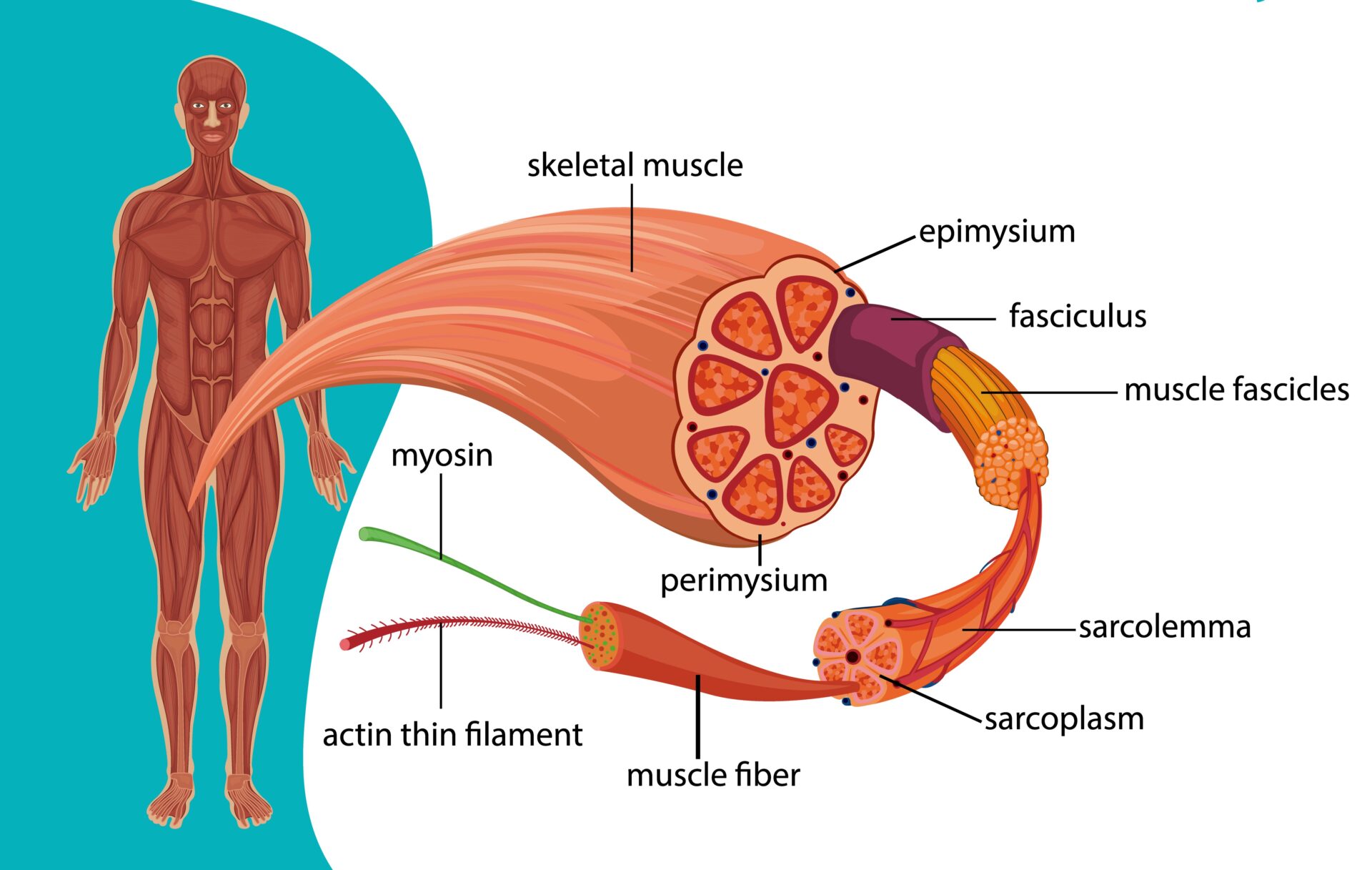
These filaments do not shorten. Instead, they slide past one another, creating the shortening of the muscle as a whole. This mechanism is known as the sliding filament theory, first proposed in the 1950s and still central to our understanding today (Huxley & Niedergerke, 1954).
The Role of the Nervous System in Muscle Contractions
Muscles do not act independently. They are controlled by the nervous system — specifically, motor neurons.
The process begins in the brain:
- A signal is generated in the motor cortex
- It travels down the spinal cord
- It reaches a motor neuron connected to muscle fibres
This junction between nerve and muscle is known as the neuromuscular junction.
When the signal arrives, it triggers the release of a neurotransmitter called acetylcholine. This chemical binds to receptors on the muscle fibre, initiating an electrical impulse known as an action potential (Kandel et al., 2013).
This is the moment the muscle is “told” to contract — but the real work is only just beginning.
Calcium: The Hidden Trigger
Once the action potential travels along the muscle fibre, it reaches a structure called the sarcoplasmic reticulum — a storage site for calcium ions.
In response, calcium is released into the muscle cell.
This is critical.
Calcium binds to a protein called troponin, which causes a shift in another protein, tropomyosin. This shift exposes binding sites on actin filaments that were previously blocked.
Without calcium, contraction cannot occur.
It is the gatekeeper — the signal that allows the machinery of contraction to begin (Bers, 2002).
The Sliding Filament Mechanism
With binding sites exposed, the interaction between actin and myosin can begin.
This process is often referred to as the cross-bridge cycle:
- Attachment
Myosin heads bind to exposed sites on actin - Power Stroke
The myosin head pivots, pulling the actin filament inward - Detachment
ATP binds to the myosin head, causing it to release - Reactivation
ATP is broken down, re-cocking the myosin head for another cycle
This cycle repeats rapidly — multiple times per second — resulting in the shortening of the sarcomere and, ultimately, the contraction of the muscle (Sweeney & Hammers, 2018).
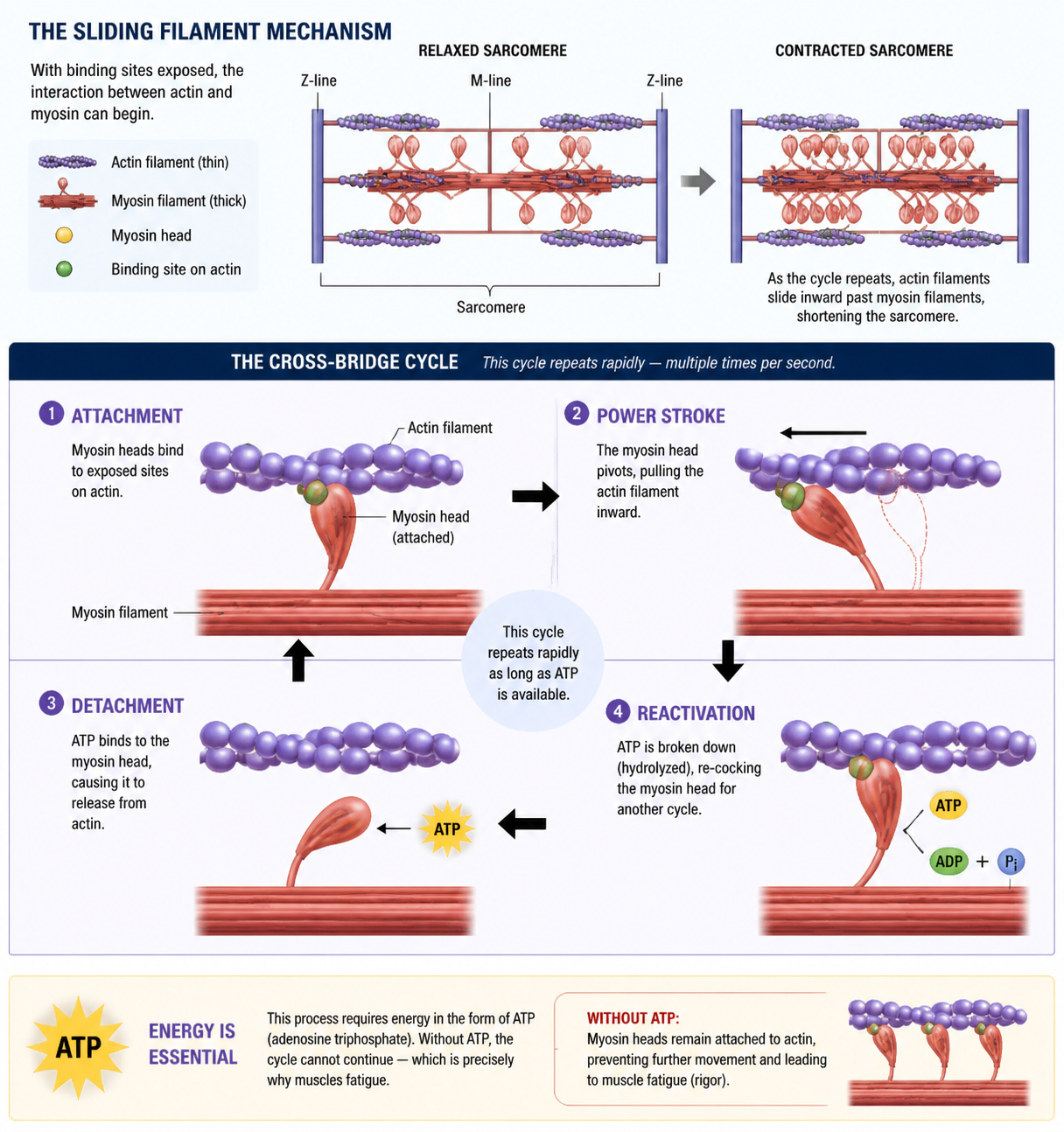
Importantly, this process requires energy in the form of ATP (adenosine triphosphate). Without ATP, the cycle cannot continue — which is precisely why muscles fatigue.
Types of Muscle Contraction
Not all contractions are created equal. The way a muscle contracts depends on the nature of the movement.
1. Concentric Contraction
The muscle shortens as it produces force (e.g. lifting a dumbbell).
2. Eccentric Contraction
The muscle lengthens under tension (e.g. lowering a weight).
Interestingly, eccentric contractions can produce greater force and are strongly associated with muscle growth and soreness (Proske & Morgan, 2001).
3. Isometric Contraction
The muscle produces force without changing length (e.g. holding a plank).
Each type has its place within a well-structured training programme — and each places slightly different demands on the muscle fibres.
Motor Units and Force Production
A single motor neuron does not control just one muscle fibre — it controls a group of them. This group is known as a motor unit.
Force production is regulated through two key mechanisms:
1. Motor Unit Recruitment
The more force required, the more motor units are activated.
Smaller, low-threshold motor units are recruited first, followed by larger, high-threshold units as demand increases.
2. Rate Coding
The frequency at which motor neurons fire also influences force. Higher firing rates produce greater force output.
This is why lifting heavier weights requires more effort — not just physically, but neurologically.
Strength is as much a function of the nervous system as it is of muscle tissue (Enoka & Duchateau, 2017).
Muscle Fibre Types: Not All Fibres Are Equal
Muscle fibres differ in their structure and function:
Type I (Slow-Twitch)
- High endurance
- Resistant to fatigue
- Lower force production
- Dominant in aerobic activities
Type II (Fast-Twitch)
- High force production
- Fatigue more quickly
- Essential for strength and power
Type II fibres can be further divided into subtypes, but for practical purposes, the distinction is clear:
endurance vs power.
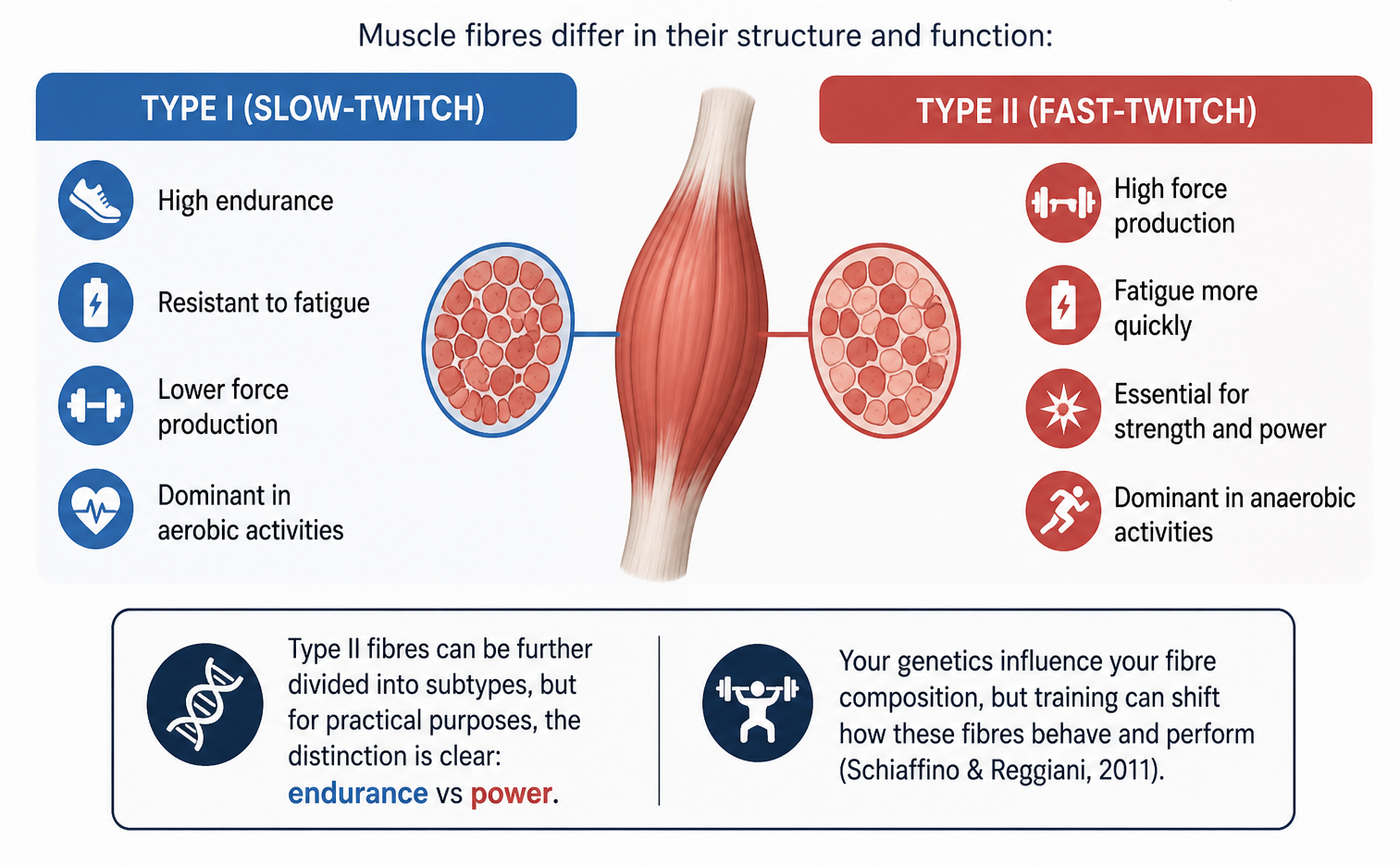
Your genetics influence your fibre composition, but training can shift how these fibres behave and perform (Schiaffino & Reggiani, 2011).
Fatigue: Why Muscles Eventually Fail
Muscle contraction cannot continue indefinitely. Fatigue is inevitable — and it occurs for several reasons:
- ATP depletion
- Accumulation of metabolic by-products (e.g. hydrogen ions)
- Reduced calcium release
- Central nervous system fatigue
Fatigue is not simply a sign of weakness. It is a protective mechanism — one that prevents excessive damage to the muscle and nervous system (Allen et al., 2008).
Understanding fatigue allows you to manage training volume, intensity, and recovery more effectively.
The Link to Training and Hypertrophy
So how does all of this translate into real-world training?
Muscle contraction is the foundation of mechanical tension — one of the primary drivers of muscle growth.
When you lift weights:
- Muscle fibres experience tension
- Micro-damage occurs
- The body repairs and reinforces the tissue
- The muscle becomes stronger and larger over time
This process is influenced by:
- Training intensity
- Volume (sets and reps)
- Time under tension
- Exercise selection
Hypertrophy is not accidental. It is the result of repeatedly exposing muscle fibres — particularly high-threshold motor units — to sufficient mechanical stress (Schoenfeld, 2010).
Why Technique Matters More Than You Think
Once you understand how contraction works, one point becomes clear:
How you perform an exercise matters just as much as what you perform.
Poor technique reduces effective tension on the target muscle and increases reliance on momentum or secondary muscle groups.
Controlled movement, full range of motion, and deliberate execution ensure that the intended muscle fibres are doing the work.
In other words, you are not just moving weight — you are creating tension where it matters.
Recovery: Completing the Cycle
Muscle contraction is only half the story. Recovery is the other.
After contraction and training stress:
- Calcium levels return to baseline
- Energy stores (ATP, glycogen) are replenished
- Muscle fibres repair and adapt
Sleep, nutrition, and rest are not optional — they are integral to the process.
Without recovery, the system breaks down. With it, the system improves.

Muscle Contraction: What to Remember
Muscle contraction is not simply a mechanical action. It is a coordinated symphony of electrical signals, chemical reactions, and molecular interactions.
Every repetition you perform is powered by:
- Neural activation
- Calcium signalling
- Protein interaction
- Energy transfer
Understanding this does not complicate training — it refines it.
You begin to see the importance of precision. Of intent. Of consistency.
Because strength is not just built in the gym. It is built in the invisible processes that occur within every fibre, every time you train.
And when you respect those processes, progress becomes far less mysterious — and far more reliable.
References
- Huxley, H., & Niedergerke, R. (1954). Structural changes in muscle during contraction. Nature.
- Kandel, E.R., Schwartz, J.H., & Jessell, T.M. (2013). Principles of Neural Science.
- Bers, D.M. (2002). Cardiac excitation–contraction coupling. Nature.
- Sweeney, H.L., & Hammers, D.W. (2018). Muscle contraction. Cold Spring Harbor Perspectives in Biology.
- Proske, U., & Morgan, D.L. (2001). Muscle damage from eccentric exercise. Journal of Physiology.
- Enoka, R.M., & Duchateau, J. (2017). Rate coding and motor unit recruitment. Journal of Physiology.
- Schiaffino, S., & Reggiani, C. (2011). Fiber types in skeletal muscle. Physiological Reviews.
- Allen, D.G., Lamb, G.D., & Westerblad, H. (2008). Skeletal muscle fatigue. Physiological Reviews.
- Schoenfeld, B.J. (2010). The mechanisms of muscle hypertrophy and their application to resistance training.Journal of Strength and Conditioning Research.