
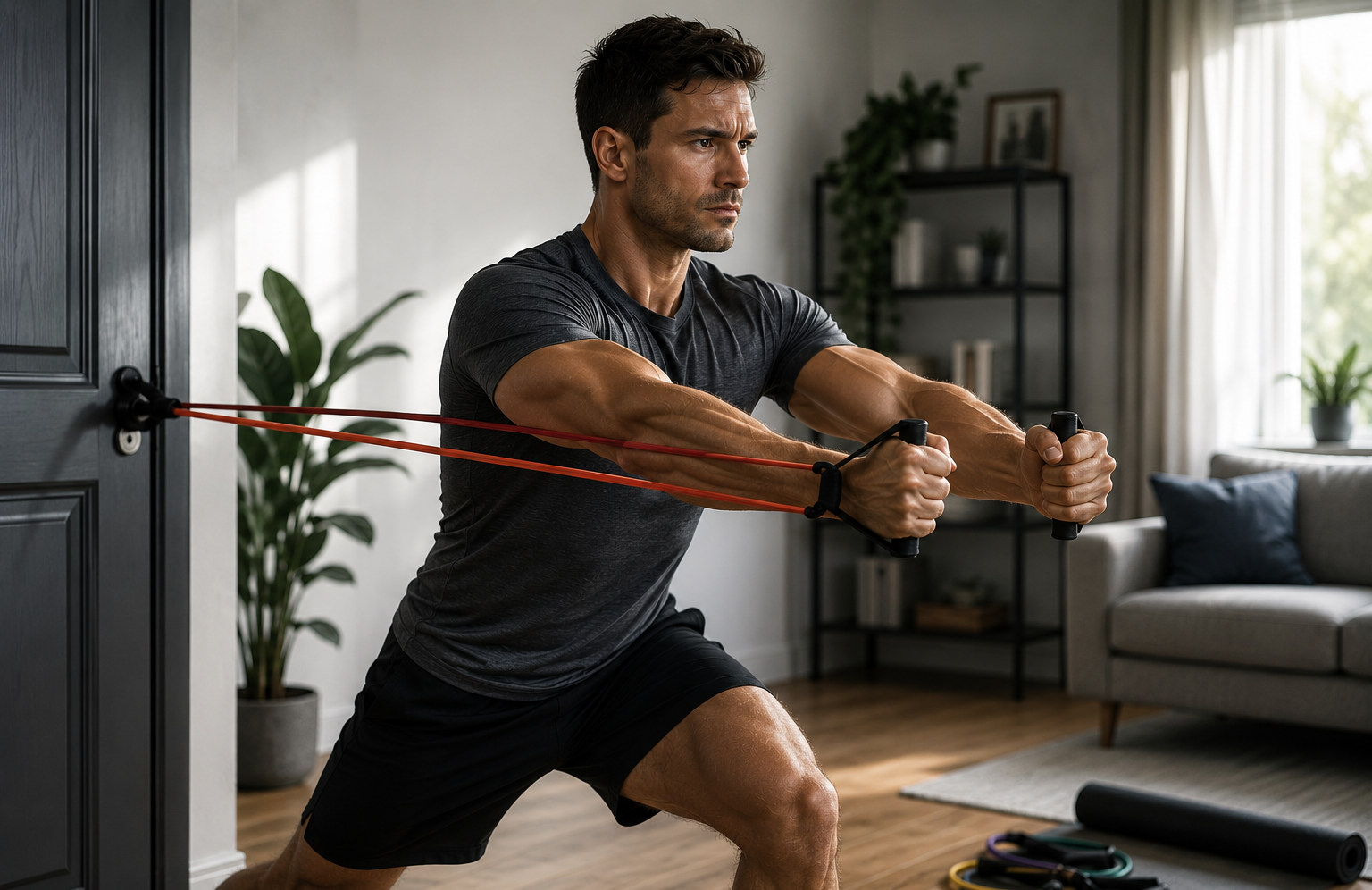
Resistance bands are often treated as something to use for warming up, rehabilitation or light exercise. In reality, a good set of bands can provide a challenging upper-body workout without requiring a rack of dumbbells, a cable machine or a gym membership.
Bands are particularly useful at home because they are inexpensive, easy to store and adaptable to a wide range of exercises. By changing the thickness of the band, shortening its length or standing farther from the anchor point, you can make the same movement considerably harder.
This 45-minute upper-body resistance band workout trains the chest, back, shoulders, biceps and triceps. It includes seven exercises arranged in a sensible order, beginning with the larger compound movements before moving into more focused shoulder and arm work.
The aim is not to rush through as many repetitions as possible. Each exercise should be performed with enough resistance to challenge the target muscles while allowing you to control both the lifting and returning phases.
What Equipment Do You Need?
For the full workout, you will ideally need:
- One or more long resistance bands
- A secure door anchor or fixed anchor point
- A light band for shoulder raises and flyes
- A medium or heavier band for presses and rows
- A clear area with enough room to extend your arms
- An exercise mat, if performing banded press-ups
Bands with removable handles can make pressing and rowing more comfortable, but ordinary looped bands also work.
Before every session, inspect the bands for:
- Cracks
- Fraying
- Small tears
- Thinning sections
- Damage around handles or clips
Do not use a damaged band. The greater the stretch, the more force the band stores, so a secure anchor and undamaged equipment are essential.

Muscles Trained in This Upper-Body Band Workout
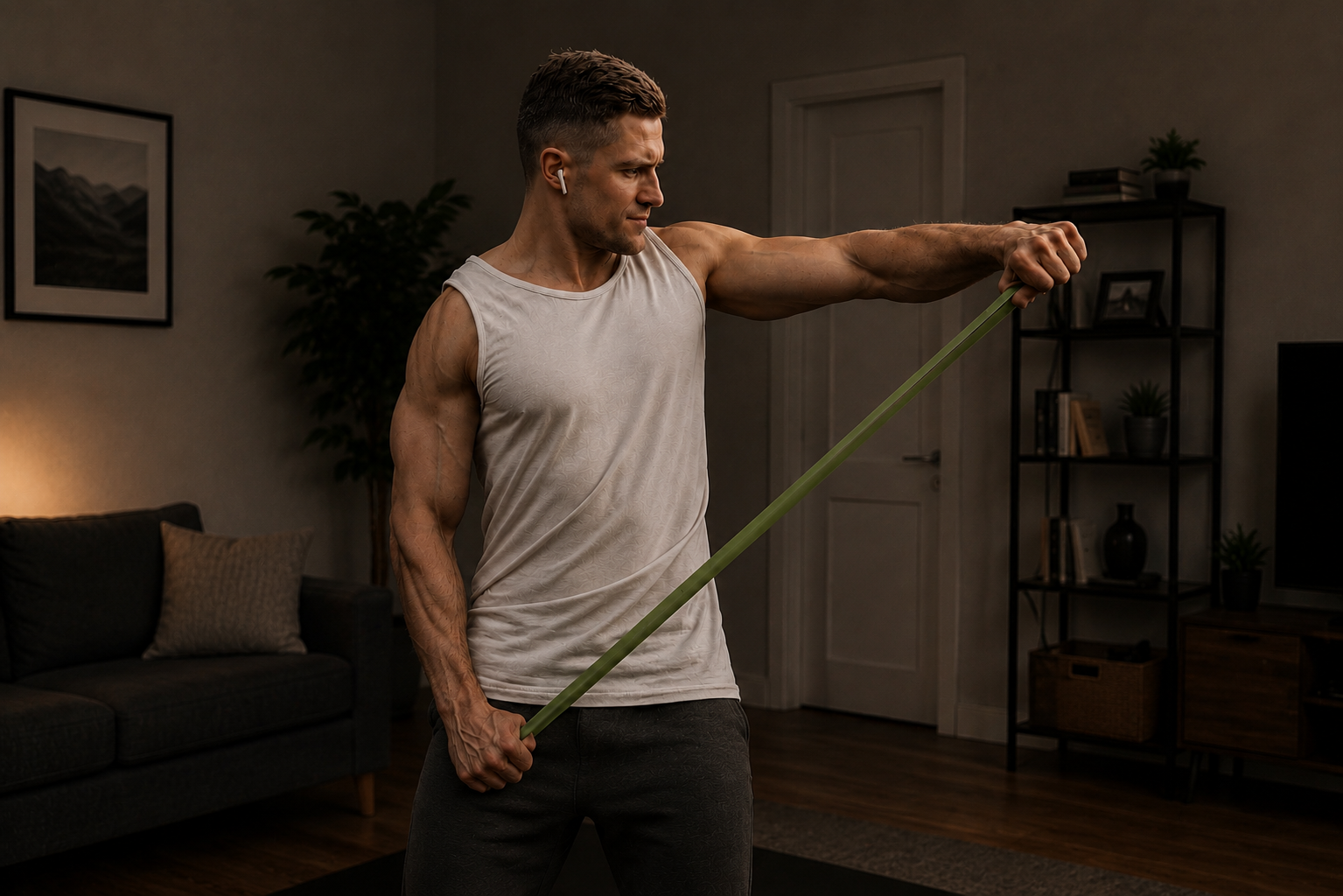
The session trains all of the major upper-body muscle groups.
Chest
The pectoralis major is responsible for pressing the arms forwards and drawing them across the body.
It is trained through:
- Banded chest presses
- Banded press-ups
- Single-arm banded chest flyes
Back
The latissimus dorsi, rhomboids, trapezius and rear shoulders help pull the arms backwards and control the shoulder blades.
They are trained through:
- Single-arm banded rows
- Controlled shoulder-blade retraction
Shoulders
The deltoids cover the front, side and rear portions of the shoulder.
They are trained through:
- Banded shoulder presses
- Banded lateral raises or shoulder flyes
- Chest pressing and rowing movements
Biceps
The biceps bend the elbow and assist during pulling exercises.
They are trained directly through:
- Banded biceps curls
They also assist during single-arm rows.
Triceps
The triceps straighten the elbow during pressing movements.
They are trained through:
- Banded chest presses
- Banded press-ups
- Banded shoulder presses
- Banded triceps extensions or pushdowns
The 45-Minute Upper-Body Band Workout
The workout is divided into four sections:
- Five-minute warm-up
- Three paired exercise blocks
- One final arm exercise
- Short cool-down
Pairing exercises as supersets keeps the workout moving without forcing the same muscle group to work continuously.
Workout Overview
| Exercise | Sets | Repetitions |
|---|---|---|
| Banded Chest Press or Banded Press-Up | 3 | 8–15 |
| Single-Arm Banded Row | 3 | 10–15 each side |
| Banded Shoulder Press | 3 | 8–15 |
| Single-Arm Banded Chest Fly | 3 | 10–15 each side |
| Banded Lateral Raise | 3 | 12–20 |
| Banded Biceps Curl | 3 | 10–20 |
| Banded Triceps Extension or Pushdown | 3 | 10–20 |
Rest for approximately:
- 15–30 seconds between exercises in a pair
- 60–75 seconds after completing both exercises
- 60 seconds between the final arm sets
Suggested 45-Minute Schedule
Minutes 0–5: Warm-Up
Complete:
- Arm circles
- Shoulder rolls
- Band pull-aparts
- Light band rows
- Easy press-ups against a wall or worktop
Minutes 5–15: Chest Press and Row Superset
Alternate:
- Banded chest press or press-up
- Single-arm banded row
Complete three rounds.
Minutes 15–25: Shoulder Press and Chest Fly Superset
Alternate:
- Banded shoulder press
- Single-arm chest fly
Complete three rounds.
Minutes 25–35: Lateral Raise and Biceps Curl Superset
Alternate:
- Banded lateral raise
- Banded biceps curl
Complete three rounds.
Minutes 35–42: Triceps Work
Perform three sets of:
- Banded triceps extensions or pushdowns
Minutes 42–45: Cool-Down
Use gentle chest, shoulder and back stretches.
The exact duration will vary slightly according to your rest periods and how long it takes to change band positions.
Exercise 1: Banded Chest Press
Muscles Worked
- Pectoralis major
- Anterior deltoids
- Triceps
- Core stabilisers
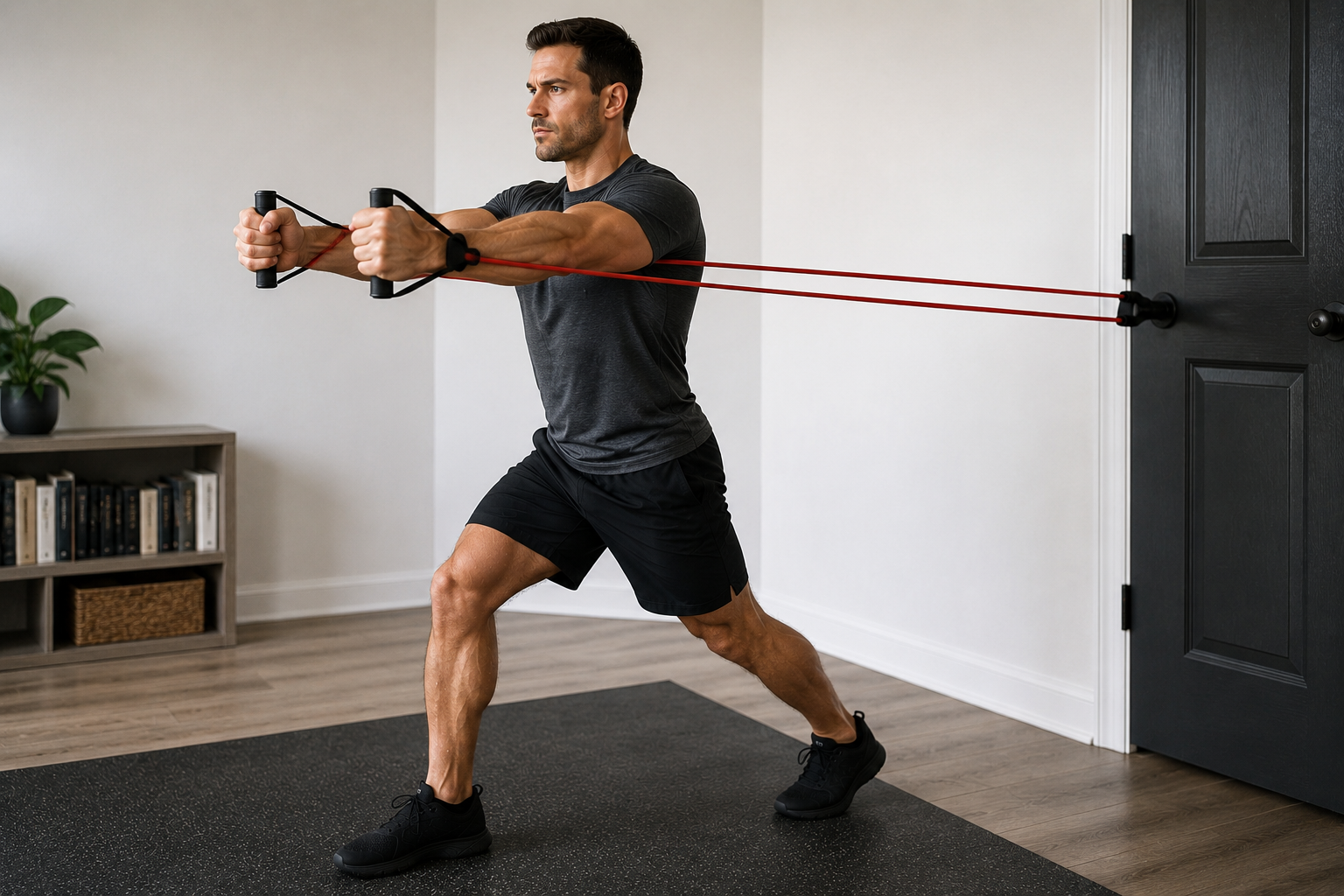
The banded chest press is the home equivalent of a cable or machine chest press.
How to Perform It
- Secure the band behind you at approximately chest height.
- Face away from the anchor point.
- Hold one end or handle in each hand.
- Use a staggered stance for stability.
- Position your hands beside your chest.
- Keep your elbows slightly below shoulder height.
- Brace your core and keep your ribcage controlled.
- Press both hands forwards until your arms are nearly straight.
- Squeeze your chest briefly.
- Return slowly until your hands are beside your torso.
The band becomes harder to stretch as the hands travel forwards. This creates the greatest resistance near the fully pressed position.
Avoid allowing the band to pull your arms backwards quickly.
Common Mistakes
- Arching the lower back
- Flaring the elbows directly sideways
- Shrugging the shoulders
- Allowing the wrists to bend
- Returning too quickly
- Standing too close to the anchor
Alternative: Banded Press-Up
A banded press-up is an excellent option when you do not have a suitable anchor point.
How to Perform It
- Place the band across your upper back.
- Hold or trap each end beneath your hands.
- Begin in a press-up position.
- Keep your body in a straight line.
- Lower your chest towards the floor.
- Press back upwards against the increasing band tension.
- Keep your core and glutes engaged.
The band should sit across the upper back rather than the neck.
Beginner Options
Use:
- A standard press-up without a band
- A kneeling press-up
- An incline press-up against a stable bench or sofa
Choose either the banded chest press or banded press-up for the workout. You do not need to perform both unless you deliberately want additional chest volume.
Exercise 2: Single-Arm Banded Row
Muscles Worked
- Latissimus dorsi
- Rhomboids
- Middle trapezius
- Rear deltoid
- Biceps
- Core
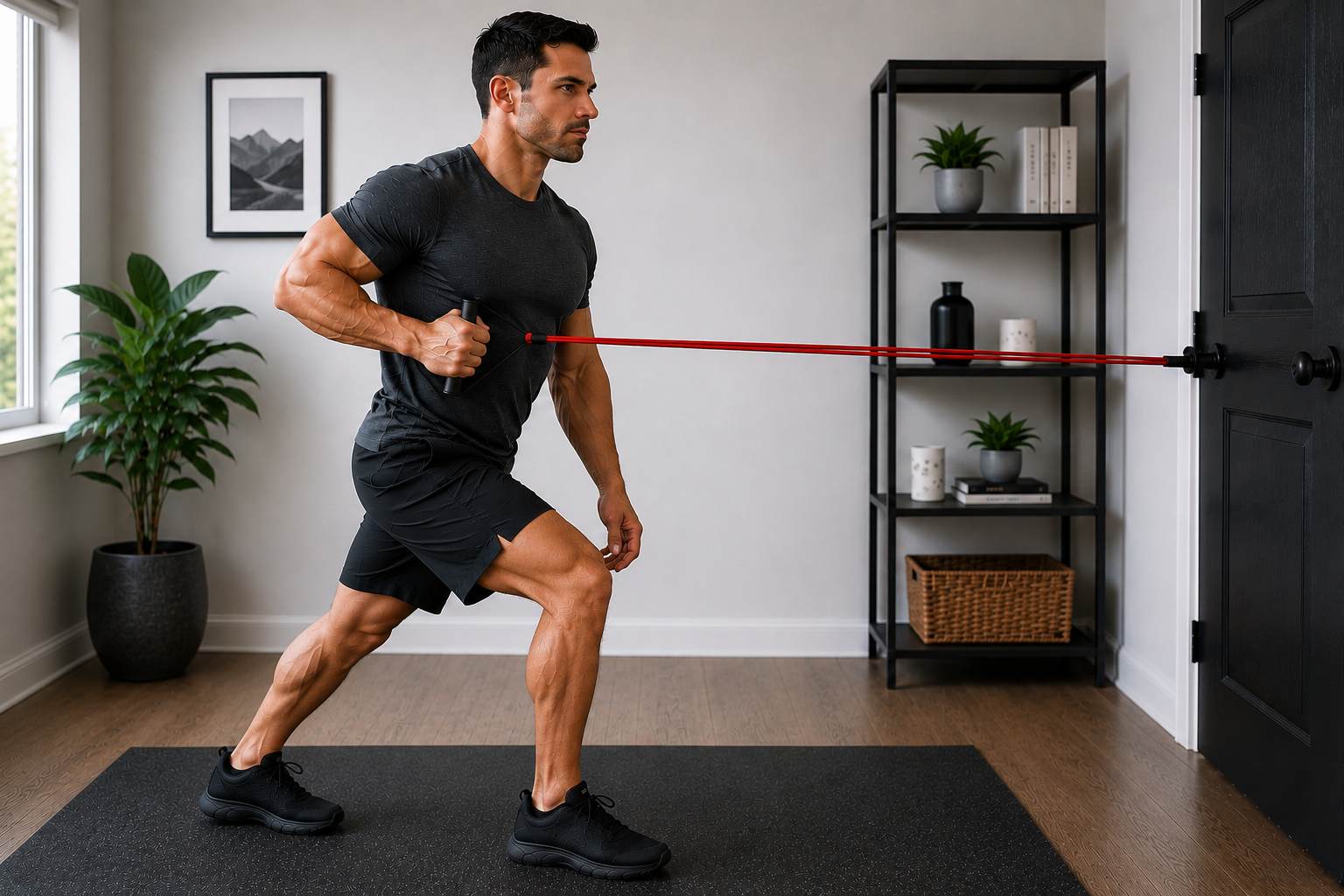
The single-arm banded row trains the back while allowing each side to work independently.
How to Perform It
- Attach the band at approximately waist or lower-chest height.
- Face the anchor point.
- Hold the band in one hand.
- Step backwards until there is tension with your arm extended.
- Use a staggered or shoulder-width stance.
- Keep your chest lifted and core braced.
- Begin by drawing your shoulder blade backwards.
- Drive your elbow behind and slightly around your torso.
- Pause when you feel a strong back contraction.
- Extend your arm slowly and allow the shoulder blade to move forwards under control.
Think about moving your elbow rather than pulling with your hand.
The hand should act as the connection between your back and the band.
How Much Should You Rotate?
A small amount of controlled upper-torso rotation is acceptable.
You may rotate slightly towards the anchor during the stretch and back towards the working side during the pull. This can increase the range of motion and help create a tighter contraction.
Do not twist sharply through your hips or use rotation to throw the band backwards.
Common Mistakes
- Curling the hand towards the chest
- Shrugging the shoulder
- Rotating excessively
- Leaning backwards
- Allowing the band to snap forwards
- Using a band that is too strong
Exercise 3: Banded Shoulder Press
Muscles Worked
- Anterior deltoids
- Lateral deltoids
- Triceps
- Upper chest
- Core
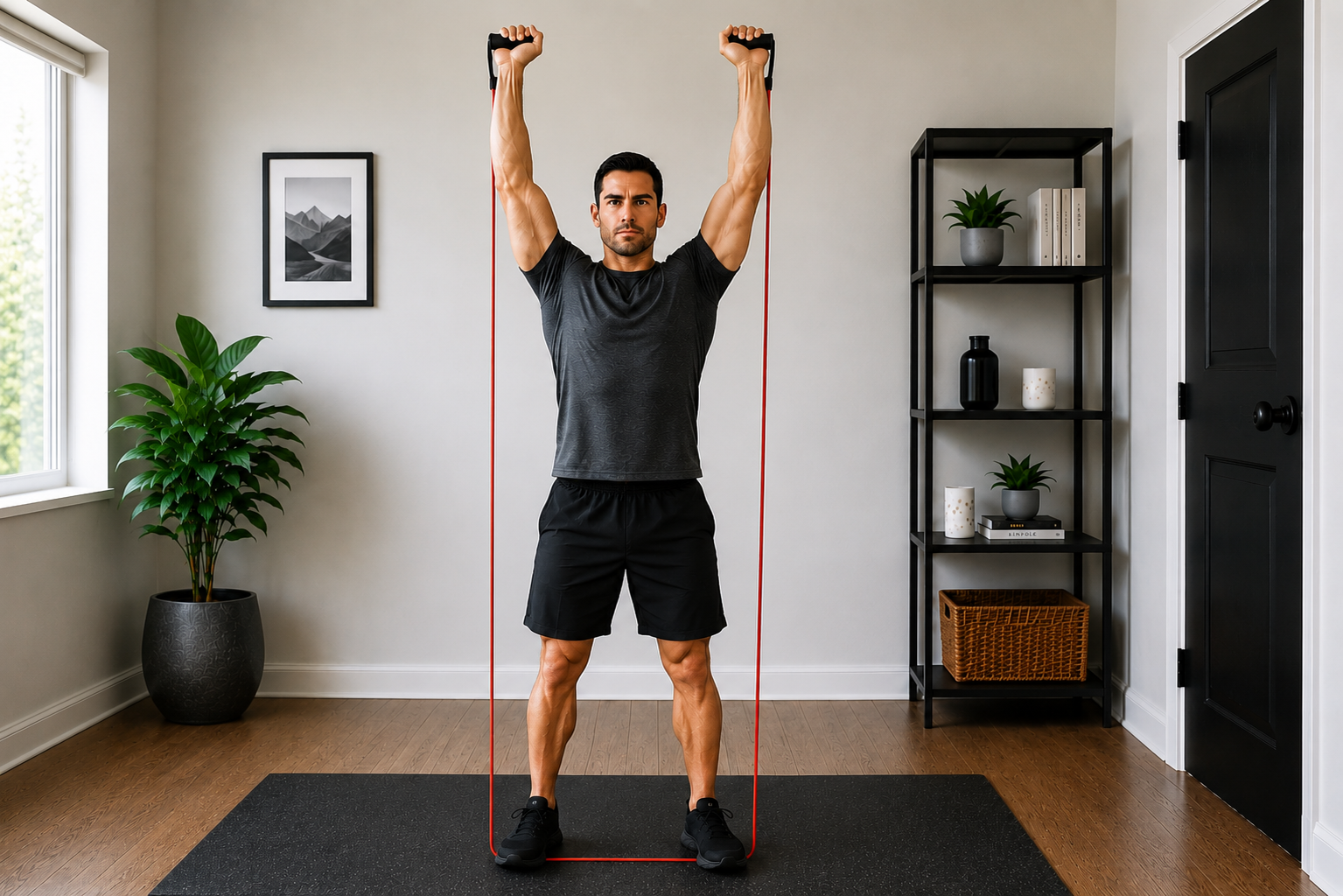
The banded shoulder press recreates the basic movement of a dumbbell or machine overhead press.
How to Perform It
- Stand on the centre of a long resistance band.
- Hold one end in each hand.
- Bring your hands to shoulder height.
- Keep your palms facing forwards or slightly inwards.
- Brace your abdominal muscles.
- Press the handles overhead.
- Finish with your arms extended without aggressively locking the elbows.
- Lower your hands slowly to shoulder height.
Keep your head neutral and avoid pushing it excessively forwards.
Common Mistakes
- Arching the lower back
- Allowing the ribs to flare
- Pressing the hands too far forwards
- Using a band that prevents a full range
- Shrugging aggressively at the start
- Rushing the return
Seated Alternative
Sit on a stable chair and place the band beneath your feet.
The seated position reduces lower-body assistance but still requires good core control.
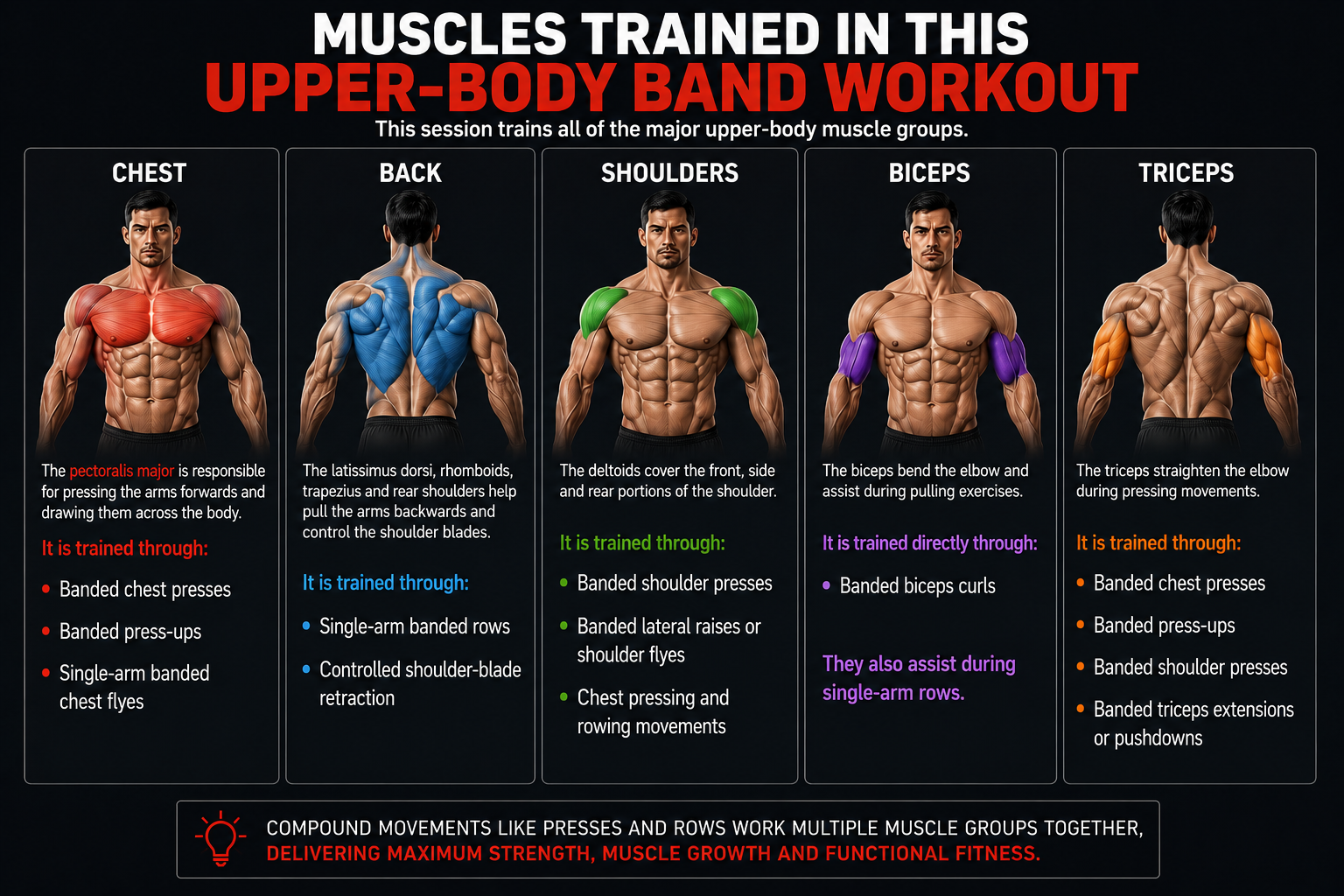
Exercise 4: Single-Arm Banded Chest Fly
Muscles Worked
- Pectoralis major
- Anterior deltoid
- Core and obliques
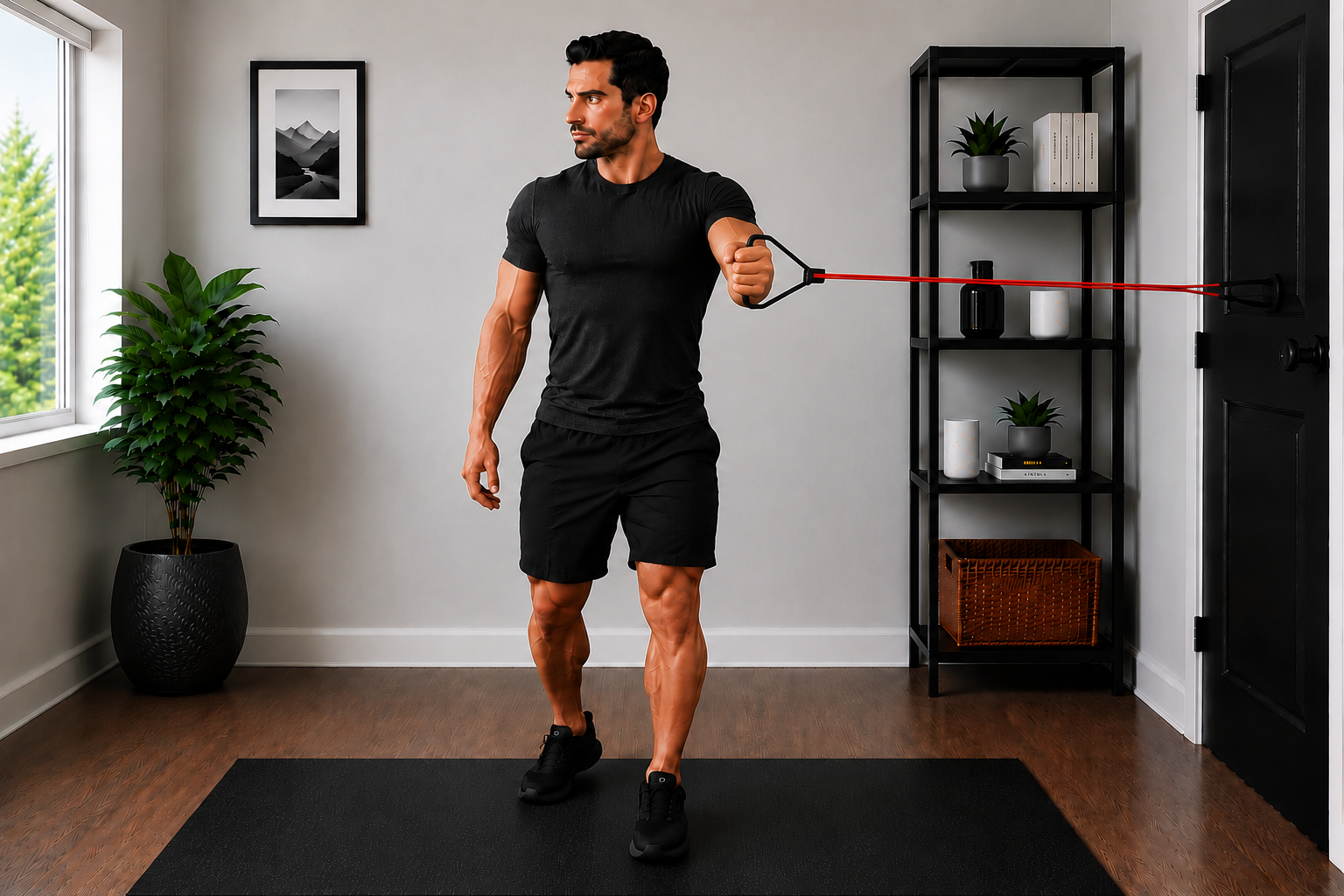
The single-arm chest fly trains the chest through horizontal adduction: bringing the upper arm across the body.
How to Perform It
- Secure the band behind you at chest height.
- Stand side-on or slightly angled away from the anchor.
- Hold the band with the arm nearest the anchor.
- Begin with your arm open and a small bend in the elbow.
- Brace your torso.
- Sweep your arm across the front of your chest.
- Bring your hand towards or slightly beyond the centre line.
- Squeeze the chest.
- Return slowly to the open position.
Maintain approximately the same elbow angle throughout the repetition.
Think about bringing the upper arm across your chest rather than pressing with your hand.
Why Perform It One Arm at a Time?
The single-arm version allows:
- Greater movement across the body
- A stronger peak contraction
- Better focus on each side
- More core involvement
- Easier adjustment of the arm path
Common Mistakes
- Turning the exercise into a press
- Twisting the entire torso
- Starting with the arm too far behind the body
- Straightening and bending the elbow
- Using too much tension
- Allowing the shoulder to roll forwards
Exercise 5: Banded Lateral Raise
Muscles Worked
- Lateral deltoid
- Supraspinatus
- Upper trapezius as a stabiliser
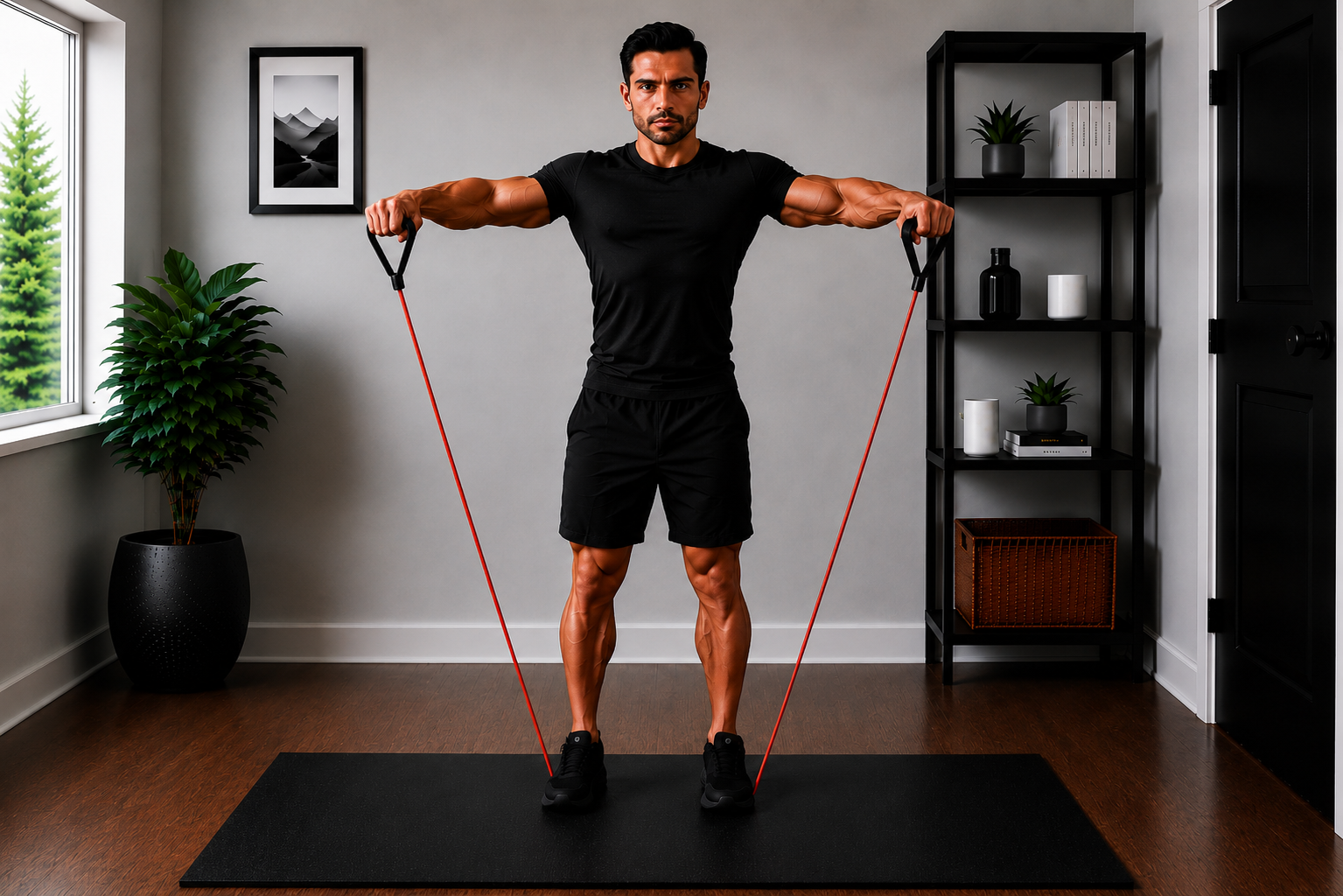
Banded lateral raises, sometimes called banded shoulder flyes, focus on the outside of the shoulders.
How to Perform It
- Stand on the middle of a light band.
- Hold an end in each hand.
- Keep a small bend in your elbows.
- Stand tall with your shoulders away from your ears.
- Raise your arms out to the sides.
- Reach as wide as possible.
- Stop near shoulder height.
- Lower slowly.
Think about pushing the walls apart rather than lifting your hands upwards.
This helps keep the movement wide and reduces excessive shrugging.
Why Use a Light Band?
The resistance increases rapidly as the band stretches.
A heavy band may make the upper part of the repetition impossible without:
- Shrugging
- Bending the elbows
- Swinging
- Shortening the range
Use a band light enough to let you reach shoulder height under control.
Single-Arm Alternative
Stand on one end of the band and raise one arm at a time.
This makes it easier to adjust resistance by changing the amount of band beneath your foot.
Exercise 6: Banded Biceps Curl
Muscles Worked
- Biceps brachii
- Brachialis
- Brachioradialis
- Forearm muscles
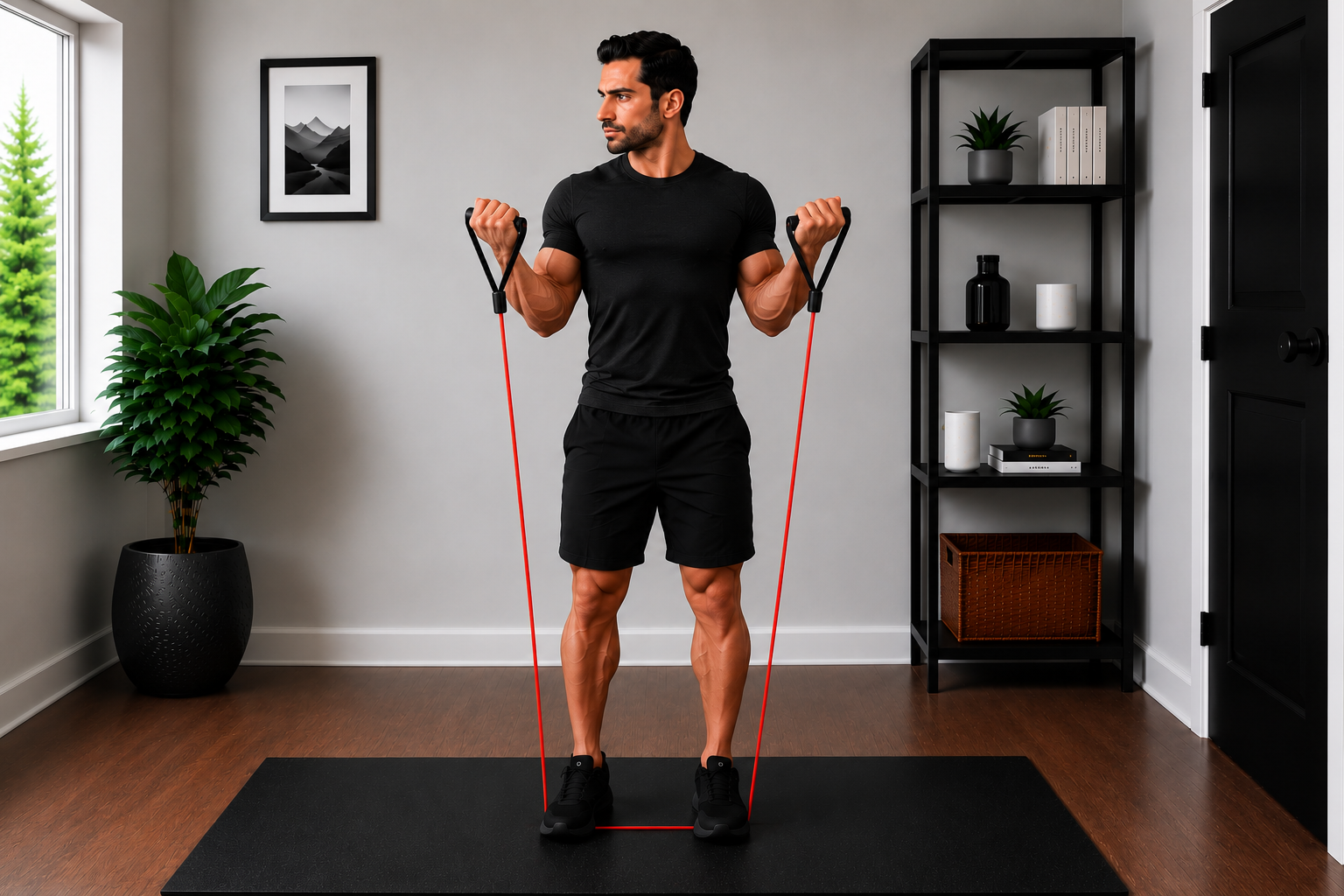
Banded curls become increasingly difficult as the hands approach the shoulders.
How to Perform Them
- Stand on the centre of the band.
- Hold one end in each hand.
- Keep your chest lifted.
- Position your elbows beside your torso.
- Curl your hands towards your shoulders.
- Keep the elbows relatively still.
- Squeeze the biceps briefly.
- Lower slowly until the arms are extended.
Do not allow your torso to rock backwards.
Grip Options
You can use:
- Palms-up curls for the biceps
- Neutral-grip hammer curls for greater brachialis and forearm involvement
- Alternating curls to focus on one arm at a time
Common Mistakes
- Moving the elbows forwards
- Bending the wrists
- Leaning backwards
- Shortening the bottom position
- Using the hips to start each repetition
Exercise 7: Banded Triceps Extension or Pushdown
Muscles Worked
- Triceps brachii
- Shoulder stabilisers
The triceps make up a large proportion of the upper arm and are involved in every pressing exercise in this workout.
Choose either an overhead extension or a pushdown depending on your equipment and anchor position.
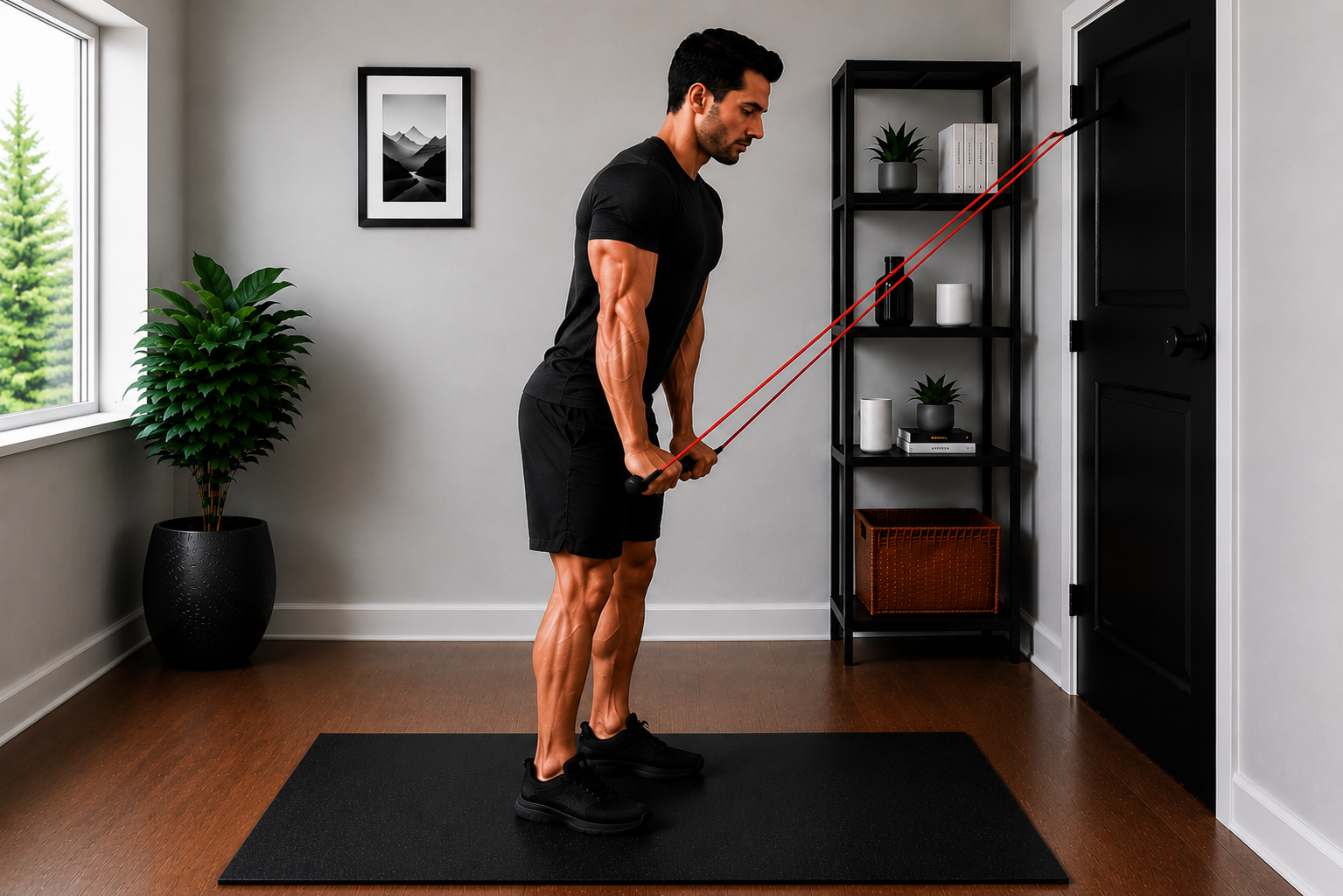
Option 1: Banded Triceps Pushdown
How to Perform It
- Secure the band above head height.
- Face the anchor.
- Hold the band with both hands.
- Keep your elbows close to your sides.
- Begin with the elbows bent.
- Push your hands down until the arms are nearly straight.
- Squeeze the triceps.
- Return slowly without allowing the elbows to move forwards.
Common Mistakes
- Moving the shoulders
- Flaring the elbows
- Leaning heavily over the band
- Allowing the hands to spring upwards
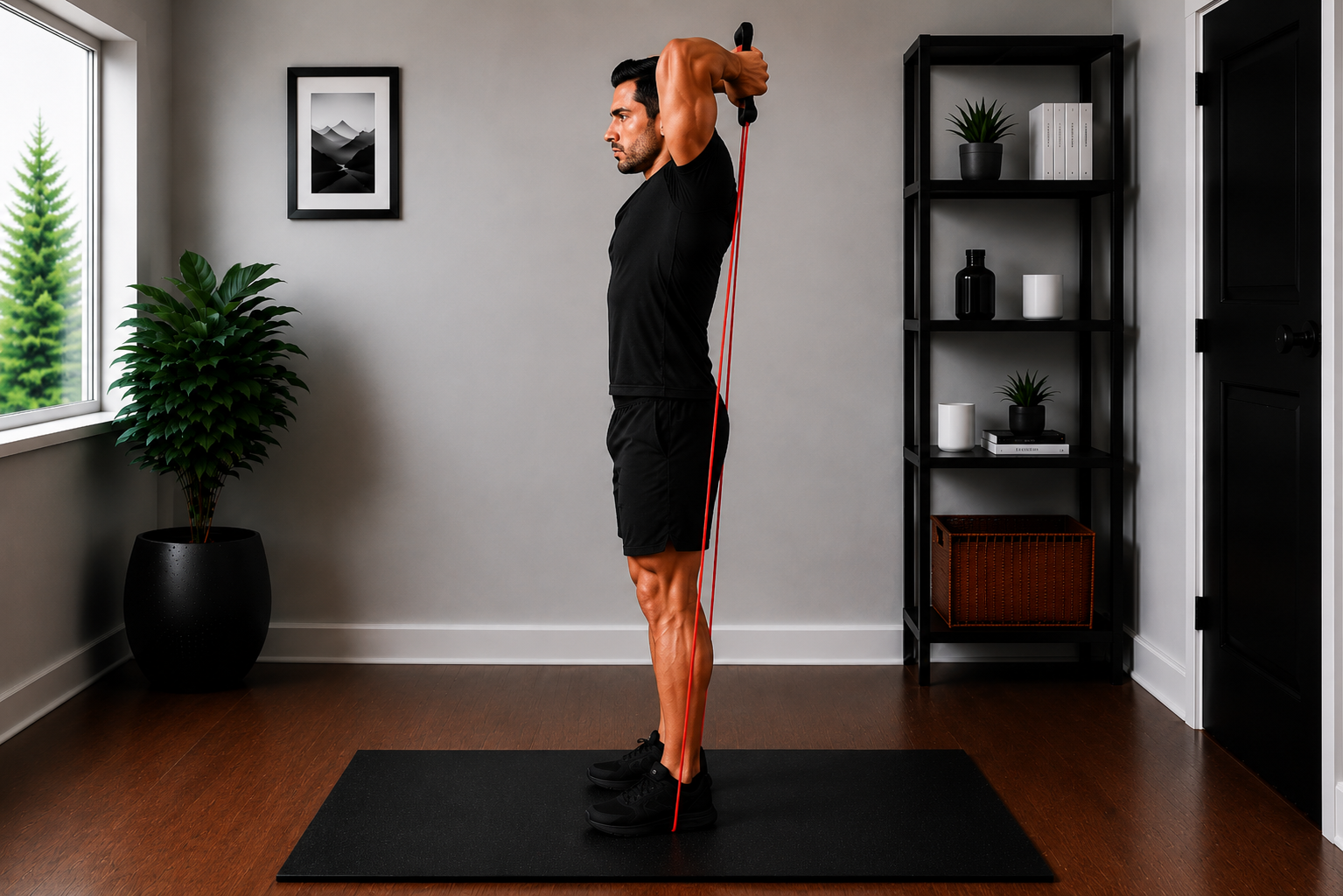
Option 2: Overhead Banded Triceps Extension
How to Perform It
- Stand on one end of the band or anchor it behind you.
- Hold the other end overhead.
- Bend your elbows so your hands move behind your head.
- Keep your elbows pointing generally forwards.
- Extend your arms overhead.
- Contract the triceps.
- Lower slowly.
The overhead position places the long head of the triceps in a lengthened position.
Choose the variation that feels most comfortable on your elbows and shoulders.
How to Choose the Right Resistance Band
A suitable band should allow you to reach the bottom of the target repetition range with good technique while making the final few repetitions challenging.
The band is probably too strong when:
- You cannot complete the full range
- Your posture changes dramatically
- The movement becomes jerky
- You must shorten or bend your arms
- You cannot control the return
The band may be too light when:
- You can perform far more than the target repetitions
- The final repetitions require little effort
- You cannot feel meaningful resistance at the hardest point
- Your technique remains unchanged despite very high repetitions
Different exercises will require different bands.
You may use:
- A heavier band for rows and chest presses
- A medium band for shoulder presses and curls
- A light band for lateral raises and chest flyes
Progressive Overload With Resistance Bands
To build strength or muscle, the exercises must gradually become more challenging.
This is known as progressive overload.
Bands do not display their resistance as clearly as a dumbbell or weight stack, but progress can still be measured.
Use a Stronger Band
Move to a thicker or stronger band once you can complete the top of your target repetition range with good form.
Do not make such a large jump that your range of motion collapses.
Shorten the Band
Holding the band closer to the anchor or standing on a larger section reduces its available length.
This increases the starting tension.
Stand Farther From the Anchor
For anchored exercises, take a small step away from the attachment point.
This creates more tension before the repetition begins.
Make sure the anchor remains secure.
Add Repetitions
For example:
- Week 1: 10 repetitions
- Week 2: 12 repetitions
- Week 3: 14 repetitions
- Week 4: Increase resistance and return to 10 repetitions
This is a simple form of double progression.
Add Sets
Move from two sets to three, or from three sets to four, when extra volume is appropriate.
Do not add sets automatically if recovery or performance is declining.
Slow the Returning Phase
Take three or four seconds to return to the starting position.
This increases time under tension without changing the band.
Add a Pause
Hold the hardest position for one to three seconds.
This works especially well for:
- Chest flyes
- Rows
- Biceps curls
- Triceps pushdowns
- Lateral raises
Improve the Range of Motion
A fuller controlled range can represent progress even when the band remains unchanged.
Do not force extra range through an uncomfortable joint position.
Train Closer to Failure
You can gradually reduce the number of repetitions you leave in reserve.
For example:
- Begin with three repetitions in reserve
- Progress towards one or two repetitions in reserve
- Occasionally take the final set to technical failure
Technical failure occurs when you can no longer perform another repetition without losing form.
Combine Bands
Two lighter bands may be used together when the next individual band is too strong.
Check that both are securely attached and in good condition.
Track Band Position
Record:
- Band colour or resistance level
- Distance from the anchor
- Hand position
- Number of repetitions
- Number of sets
- Tempo used
Without a consistent setup, it becomes difficult to tell whether you are genuinely progressing.
Should You Perform the Workout as a Circuit?
You can perform the exercises as one continuous circuit, but this will increase cardiovascular fatigue and may reduce strength performance.
For building muscle, the paired format in this article is generally more practical.
It allows one muscle group to recover while another works.
For example:
- Chest press followed by row
- Shoulder press followed by fly
- Lateral raise followed by curl
A full circuit may be useful when:
- Time is very limited
- General fitness is the main goal
- You have good exercise technique
- The bands and anchor points can be changed quickly
How Often Should You Perform This Workout?
For most people:
- Beginners: twice per week
- Intermediate trainees: two or three times per week
- Experienced trainees: use it as part of a wider programme
Allow at least one full recovery day between demanding upper-body sessions.
You could combine it with lower-body training as follows:
| Day | Training |
|---|---|
| Monday | Upper-body band workout |
| Tuesday | Lower body or walking |
| Wednesday | Rest |
| Thursday | Upper-body band workout |
| Friday | Lower body or cardio |
| Saturday | Light activity |
| Sunday | Rest |
Can Resistance Bands Build Muscle?
Resistance bands can contribute to muscle growth when the muscles are trained through a controlled range and the sets become progressively more challenging.
The main requirements remain:
- Sufficient resistance
- Training reasonably close to failure
- Progressive overload
- Adequate weekly volume
- Enough protein and calories
- Proper recovery
Bands have a different resistance profile from free weights. They usually become harder as they stretch, meaning the top or shortened position often receives the most resistance.
This can be useful, but it also means some exercises are relatively easy at the beginning.
Combining band training with bodyweight movements can help. For example, press-ups challenge the chest strongly near the bottom, while the band increases resistance as you press upwards.
Warm-Up Guidance
Spend approximately five minutes preparing the shoulders and elbows.
Complete one or two rounds of:
- 10 arm circles in each direction
- 10 shoulder-blade squeezes
- 12 light band pull-aparts
- 10 light band rows
- 8 wall or incline press-ups
- 10 gentle overhead reaches
The warm-up should increase movement and temperature without fatiguing you.
You may also perform one light preparation set before the first working set of each unfamiliar exercise.
Safety Tips for Training With Bands
Check the Anchor
A door anchor should be placed according to the manufacturer’s instructions.
Whenever possible, position it so the pulling force closes the door more firmly rather than pulling it open.
Do not attach bands to:
- Loose furniture
- Unstable railings
- Sharp objects
- Lightweight door handles
- Anything that may move or break
Protect the Band
Avoid stretching it across sharp corners, rough brickwork or exposed metal.
Repeated friction can weaken the material.
Control the Return
Never release a stretched band suddenly.
Maintain your grip and return to the start under control.
Keep Bands Away From the Face
Set up overhead exercises carefully.
Wear eye protection if recommended by the manufacturer, particularly when using older bands or unfamiliar anchor arrangements.
Stop When Pain Occurs
Muscular effort and fatigue are expected.
Sharp pain, numbness or joint instability are reasons to stop the exercise.
Common Home Band Workout Mistakes
Using One Band for Every Exercise
Your back can usually handle more resistance than your lateral deltoids.
Change the band according to the movement.
Standing Too Close to the Anchor
Starting with a completely slack band reduces resistance through much of the range.
Create a small amount of tension before beginning.
Using Excessive Starting Tension
Too much initial stretch can prevent a full repetition and place unnecessary strain on the band.
Rushing Repetitions
Fast movements reduce control and can make the band snap back.
Ignoring the Returning Phase
The exercise continues as the band shortens.
Resist it rather than allowing it to pull you back.
Allowing Posture to Change
Watch for:
- Lower-back arching
- Shoulder shrugging
- Torso twisting
- Bent wrists
- Uncontrolled leaning
Never Recording Progress
Band workouts can become repetitive when there is no progression plan.
Keep a simple training log.
Example Resistance Band Training Log
| Exercise | Band | Sets | Reps | Tempo or pause | Next target |
|---|---|---|---|---|---|
| Chest Press | |||||
| One-Arm Row | |||||
| Shoulder Press | |||||
| Chest Fly | |||||
| Lateral Raise | |||||
| Biceps Curl | |||||
| Triceps Exercise |
Making the Workout Easier
To reduce difficulty:
- Use a lighter band
- Stand closer to the anchor
- Hold the band nearer its ends
- Reduce the number of sets
- Use the lower end of the repetition range
- Perform incline press-ups
- Limit the range to a comfortable level
Making the Workout Harder
To increase difficulty:
- Use a stronger band
- Increase starting tension
- Add repetitions
- Add a fourth set
- Slow the return
- Pause at peak contraction
- Use one-and-a-half repetitions
- Finish the last set near technical failure
- Combine a band with a bodyweight exercise
Building Your Upper Body at Home
A productive upper-body workout does not depend on having access to heavy machines or a large collection of free weights. Resistance bands can train the chest, back, shoulders and arms effectively when you use enough tension, perform the movements properly and make the programme progressively harder.
Begin with the larger exercises while you are fresh. Use the chest press and single-arm row to train the main pushing and pulling muscles, then move into the shoulder press, chest fly and lateral raise before finishing with direct biceps and triceps work.
Do not judge the quality of the workout by how quickly you complete it or how much the band shakes. Focus on controlled repetitions, stable posture and a clear contraction in the intended muscle.
Record the band and setup used for each exercise. Once you can reach the top of the target repetition range without losing form, increase the challenge through additional tension, a stronger band, slower repetitions or another suitable progression.
Performed two or three times per week, this 45-minute routine can provide a balanced and convenient foundation for developing upper-body strength and muscle at home.
References
- American College of Sports Medicine. (2026). Resistance Training Prescription for Muscle Function, Hypertrophy and Physical Performance in Healthy Adults.
- American College of Sports Medicine. (2025). The ACE Workout Builder for Resistance Band Workouts.
- NHS. How to Improve Your Strength and Flexibility.
- The Royal Marsden NHS Foundation Trust. Exercise at Home: Strength Training Using Therabands.
- Schoenfeld, B.J. (2010). The mechanisms of muscle hypertrophy and their application to resistance training. Journal of Strength and Conditioning Research, 24(10), 2857–2872.
- Lopes, J., Machado, A.F., Micheletti, J.K., de Almeida, A.C., Cavina, A.P. and Pastre, C.M. (2019). Effects of training with elastic resistance versus conventional resistance on muscular strength: A systematic review and meta-analysis. SAGE Open Medicine, 7.