

Every repetition you perform in the gym — whether it is a heavy squat, a sprint, or even holding a plank — relies on a single molecule.
That molecule is ATP (adenosine triphosphate).
It does not matter how strong you are, how well you train, or how precise your nutrition is — without ATP, muscle contraction simply would not occur. It is the body’s immediate and most important source of energy.
Understanding how ATP works, how it is produced, and how it relates to training can give you a clearer picture of what is actually driving performance — and how to support it.
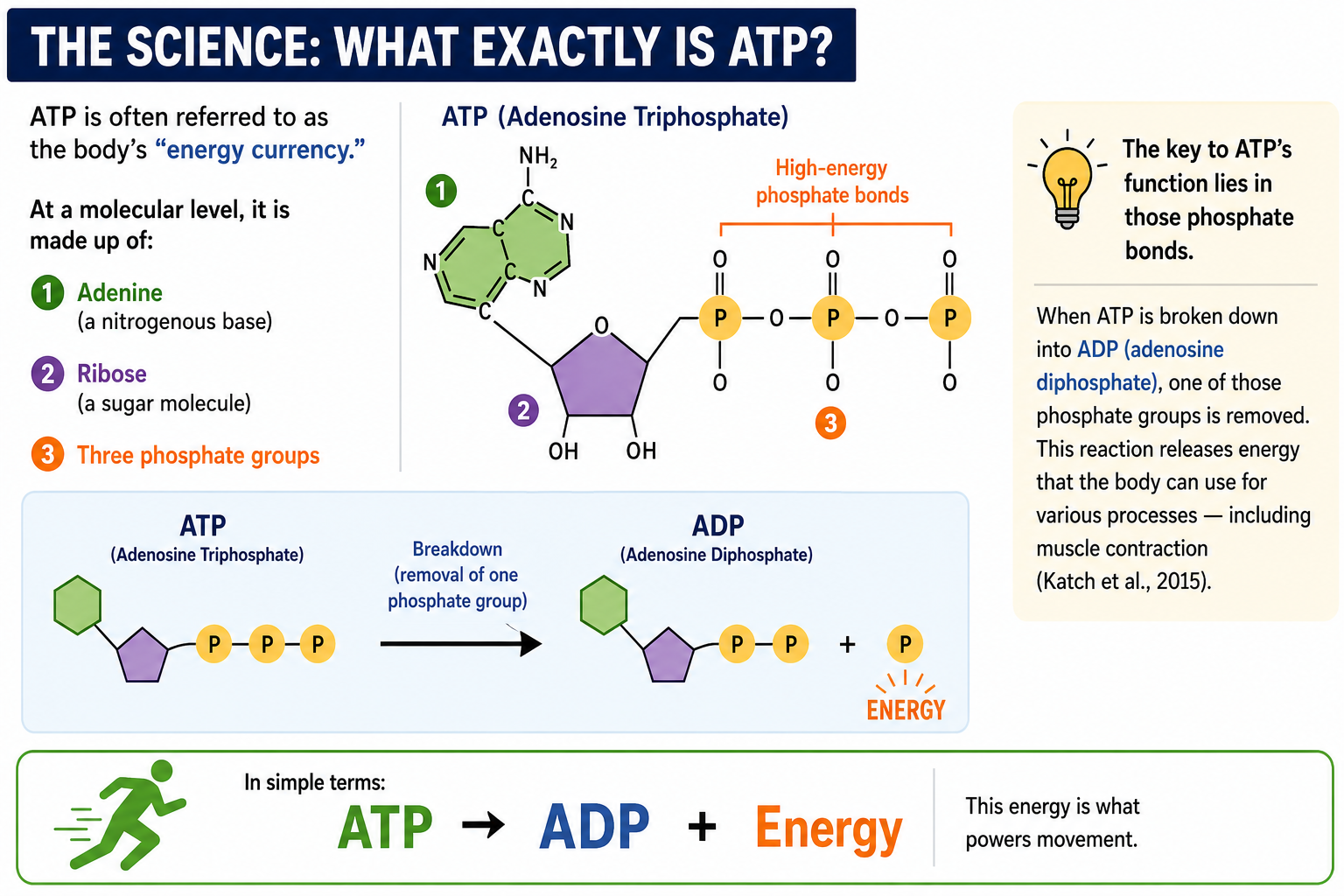
The Science: What Exactly is ATP?
ATP is often referred to as the body’s “energy currency.”
At a molecular level, it is made up of:
- Adenine (a nitrogenous base)
- Ribose (a sugar molecule)
- Three phosphate groups
The key to ATP’s function lies in those phosphate bonds.
When ATP is broken down into ADP (adenosine diphosphate), one of those phosphate groups is removed. This reaction releases energy that the body can use for various processes — including muscle contraction (Katch et al., 2015).
In simple terms:
- ATP → ADP + Energy
This energy is what powers movement.

Why ATP Matters for Muscle Contraction
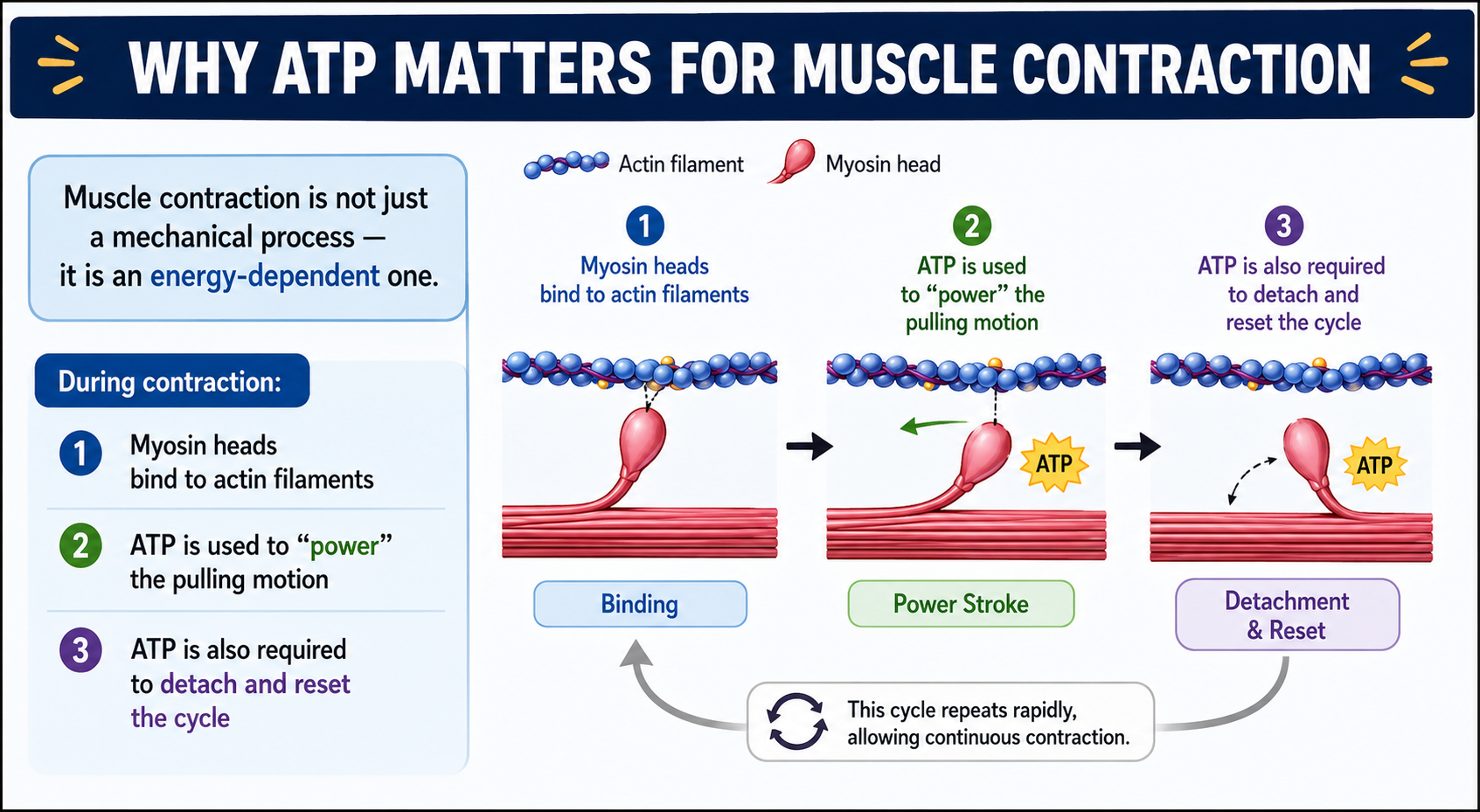
Muscle contraction is not just a mechanical process — it is an energy-dependent one.
During contraction:
- Myosin heads bind to actin filaments
- ATP is used to “power” the pulling motion
- ATP is also required to detach and reset the cycle
Without ATP, this process stops completely. In fact, the stiffness that occurs after death (rigor mortis) is caused by the absence of ATP, preventing muscles from relaxing.
In training terms, every rep you perform — no matter how small — is powered by ATP.
The Problem: ATP Is Limited
Here is the key limitation: your body stores very small amounts of ATP.
At any given moment, there is only enough ATP available to fuel:
- A few seconds of high-intensity effort
This means your body must constantly regenerate ATP to keep you moving.
To do this, it relies on three primary energy systems.
The Three Energy Systems That Produce ATP
Your body does not rely on a single method to produce ATP. Instead, it uses three overlapping systems, depending on the intensity and duration of activity.
1. The Phosphocreatine System (ATP-PC System)
This is the fastest way to regenerate ATP.
It uses phosphocreatine (stored in muscle cells) to rapidly donate a phosphate group to ADP, reforming ATP.
Key characteristics:
- Provides immediate energy
- Lasts around 5–10 seconds
- Used in explosive movements (e.g. sprinting, heavy lifting)
This is why short, high-intensity efforts rely heavily on this system.
2. The Glycolytic System
When activity lasts longer than a few seconds, the body begins breaking down carbohydrates (glucose) to produce ATP.
This process:
- Does not require oxygen (anaerobic)
- Produces energy relatively quickly
- Leads to the production of lactate
It typically fuels efforts lasting:
- Around 30 seconds to 2 minutes
Think of high-rep sets or intense intervals.
3. The Oxidative System
For longer-duration activity, the body relies on oxygen to produce ATP through the breakdown of carbohydrates and fats.
This system:
- Produces energy more slowly
- Is highly sustainable
- Supports endurance activities
It dominates during:
- Long runs
- Steady-state cardio
- Lower-intensity training
ATP and Different Types of Training
Understanding ATP helps explain why different types of training feel the way they do.
- Heavy strength training relies on the ATP-PC system
- Hypertrophy training (moderate reps) relies more on glycolysis
- Endurance training relies on oxidative pathways
All three systems are always active to some degree, but one will dominate depending on the demand.
This is why rest periods matter.
For example:
- Short rest → incomplete ATP replenishment → more fatigue
- Longer rest → more ATP restored → better performance

Nutrition and ATP Production
ATP does not appear out of nowhere. It is produced using nutrients from your diet.
Carbohydrates
Carbohydrates are a primary fuel source for ATP production, particularly during moderate to high-intensity exercise.
They:
- Replenish glycogen stores
- Support glycolytic energy production
- Improve training performance
Low carbohydrate intake can reduce your ability to sustain higher-intensity work.
Fats
Fats play a larger role in lower-intensity, longer-duration activity.
They:
- Support the oxidative energy system
- Provide a long-lasting fuel source
While not ideal for explosive efforts, they are essential for overall energy balance.
Protein
Protein is not a primary energy source, but it plays a role in:
- Muscle repair
- Enzyme production
- Overall recovery
In extreme conditions, amino acids can contribute to ATP production, but this is not their main function.
Creatine and ATP: One of the Most Effective Supplements
If there is one supplement directly linked to ATP production, it is creatine.
Creatine increases the amount of phosphocreatine stored in your muscles. This enhances your ability to rapidly regenerate ATP during high-intensity efforts.
Research consistently shows that creatine supplementation can:
- Improve strength and power output
- Increase training volume
- Enhance recovery between sets (Buford et al., 2007)
In practical terms, this means:
- More reps
- Heavier lifts
- Better performance over time
A typical protocol:
- 3–5g of creatine monohydrate per day
It is simple, well-researched, and highly effective.
Other Factors That Influence ATP Production
Beyond nutrition, several lifestyle factors affect your ability to produce and use ATP efficiently.
Sleep
Sleep supports:
- Hormonal balance
- Cellular repair
- Energy system recovery
Poor sleep reduces overall performance and recovery capacity.
Hydration
Water is essential for:
- Cellular function
- Nutrient transport
- Energy production processes
Even mild dehydration can impair performance.
Training Adaptation
Regular training improves the body’s ability to produce ATP.
Adaptations include:
- Increased mitochondrial density (for endurance)
- Improved enzyme activity
- Greater phosphocreatine storage
In simple terms, the more you train, the more efficient your energy systems become.
Practical Takeaways for Training
Understanding ATP is useful, but it should also inform how you train.
A few key points to keep in mind:
- Match rest periods to your goal (longer for strength, shorter for endurance)
- Fuel your body with sufficient carbohydrates for performance
- Consider creatine supplementation for high-intensity training
- Prioritise sleep and hydration to support recovery
You do not need to overcomplicate it — but recognising what fuels your training helps you make better decisions.
ATP sits at the centre of everything you do in training.
It powers every contraction, every rep, every movement — from the heaviest lift to the simplest exercise.
While you cannot see it, and rarely think about it, it is constantly being used and regenerated behind the scenes.
Understanding it does not just give you a deeper appreciation of how the body works — it helps you train smarter.
References
- Katch, V.L., McArdle, W.D., & Katch, F.I. (2015). Exercise Physiology: Nutrition, Energy, and Human Performance.
- Buford, T.W. et al. (2007). International Society of Sports Nutrition position stand: creatine supplementation.Journal of the International Society of Sports Nutrition.
- Hargreaves, M., & Spriet, L.L. (2020). Skeletal muscle energy metabolism during exercise. Nature Metabolism.
- Brooks, G.A. et al. (2005). Exercise Physiology: Human Bioenergetics and Its Applications.