

For many people, developing a visible six pack is one of the most common fitness goals. It’s also one of the most misunderstood. Endless crunches, sit-ups and ab machines are often marketed as the secret to sculpted abs, but the truth is far simpler. Building a strong, well-defined core requires a combination of effective abdominal training, progressive overload, and reducing overall body fat through proper nutrition.
Like any other muscle group, the abdominal muscles respond to resistance training. Simply performing hundreds of repetitions with poor technique isn’t the most effective approach. Instead, focusing on a handful of well-executed exercises can produce better strength, muscle development and definition over time.
This workout focuses on three highly effective abdominal exercises that train the upper, middle and lower portions of the rectus abdominis while also challenging the deeper core muscles. The exercises are arranged in a specific order to maximise performance, allowing you to complete the most demanding movement while you’re fresh.
If you’d like to place additional emphasis on your obliques, there’s also an optional fourth exercise to finish the abs workout.
Understanding Your Core Muscles
Before jumping into the workout, it’s worth understanding what you’re actually training.
Although people often refer to “the abs” as one muscle, the core is made up of several muscles working together.
Rectus Abdominis
The rectus abdominis is the muscle responsible for the classic six-pack appearance.
Its primary functions include:
- Spinal flexion
- Posterior pelvic tilt
- Stabilising the trunk
Although you can’t completely isolate the upper or lower abs, different exercises can place greater emphasis on certain areas by changing the movement pattern.
Internal and External Obliques
Located on either side of your abdomen, the obliques assist with:
- Rotation
- Side bending
- Core stability
- Anti-rotation
Transverse Abdominis
Often described as the body’s natural weightlifting belt, the transverse abdominis sits deep beneath the visible abdominal muscles and provides stability for the spine and pelvis.
The Best Three-Exercise Abs Workout
The workout consists of just three exercises.
Perform them in the following order:
- Hanging Leg Raises
- Cable Crunches
- Crunches
This order is intentional.
Hanging leg raises require the greatest amount of strength, coordination and grip. Performing them first allows you to maintain proper technique before abdominal fatigue begins to affect your control.
Leaving them until the end of the workout often results in excessive swinging and reduced range of motion.

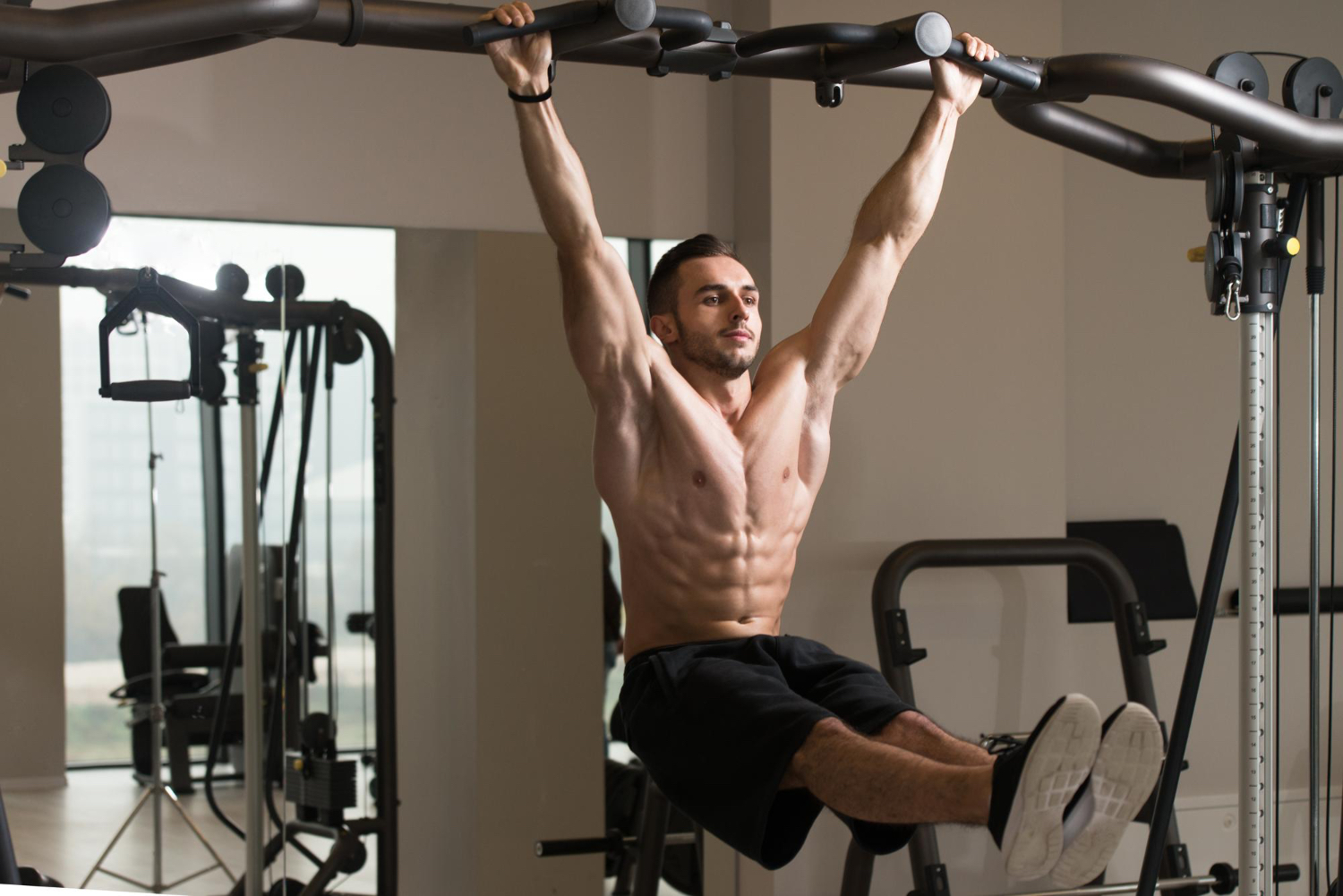
Exercise 1: Hanging Leg Raises
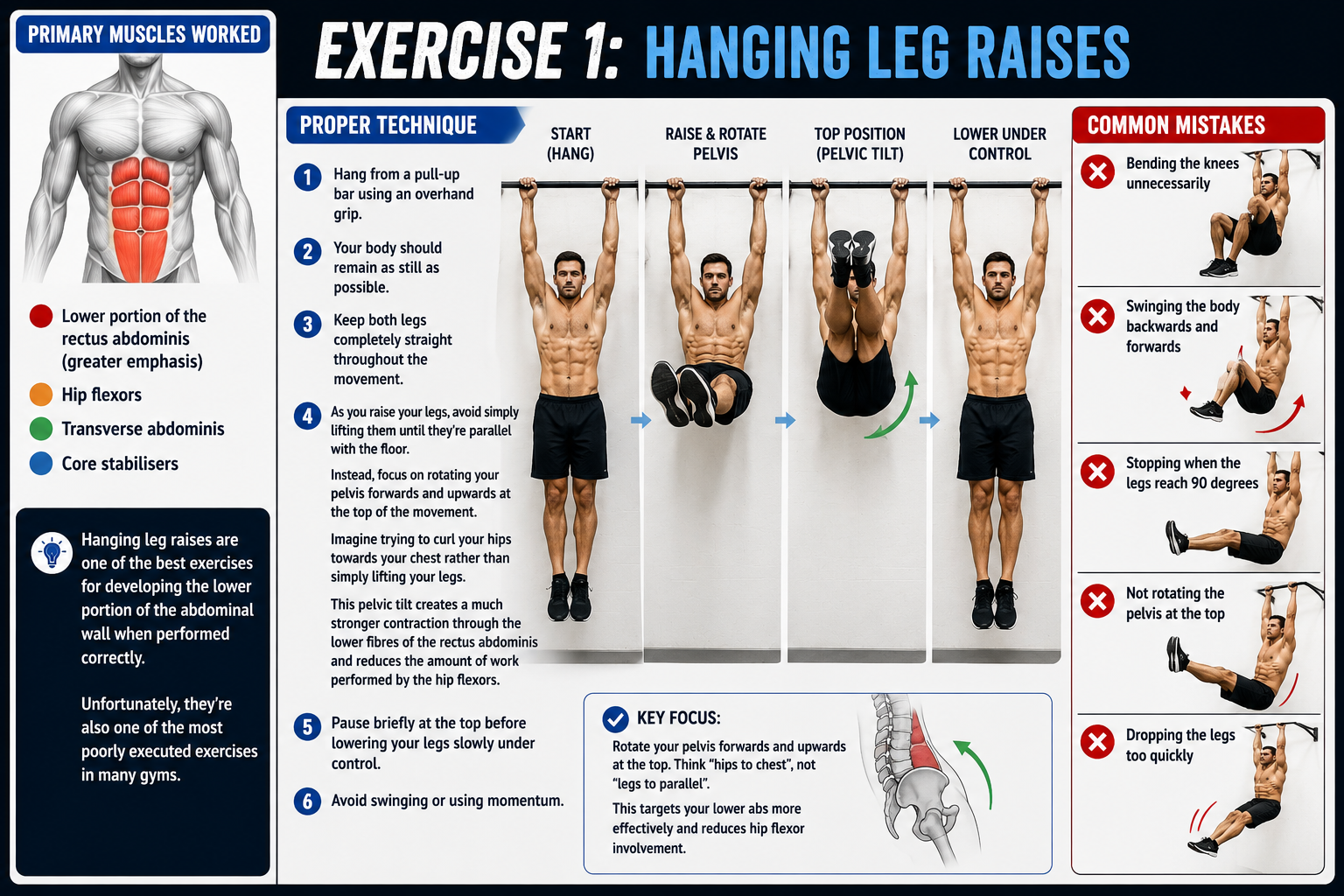
Primary Muscles Worked
- Lower portion of the rectus abdominis (greater emphasis)
- Hip flexors
- Transverse abdominis
- Core stabilisers
Hanging leg raises are one of the best exercises for developing the lower portion of the abdominal wall when performed correctly.
Unfortunately, they’re also one of the most poorly executed exercises in many gyms.
Proper Technique
Hang from a pull-up bar using an overhand grip.
Your body should remain as still as possible.
Keep both legs completely straight throughout the movement.
As you raise your legs, avoid simply lifting them until they’re parallel with the floor.
Instead, focus on rotating your pelvis forwards and upwards at the top of the movement.
Imagine trying to curl your hips towards your chest rather than simply lifting your legs.
This pelvic tilt creates a much stronger contraction through the lower fibres of the rectus abdominis and reduces the amount of work performed by the hip flexors.
Pause briefly at the top before lowering your legs slowly under control.
Avoid swinging or using momentum.
Common Mistakes
- Bending the knees unnecessarily
- Swinging the body backwards and forwards
- Stopping when the legs reach 90 degrees
- Not rotating the pelvis at the top
- Dropping the legs too quickly
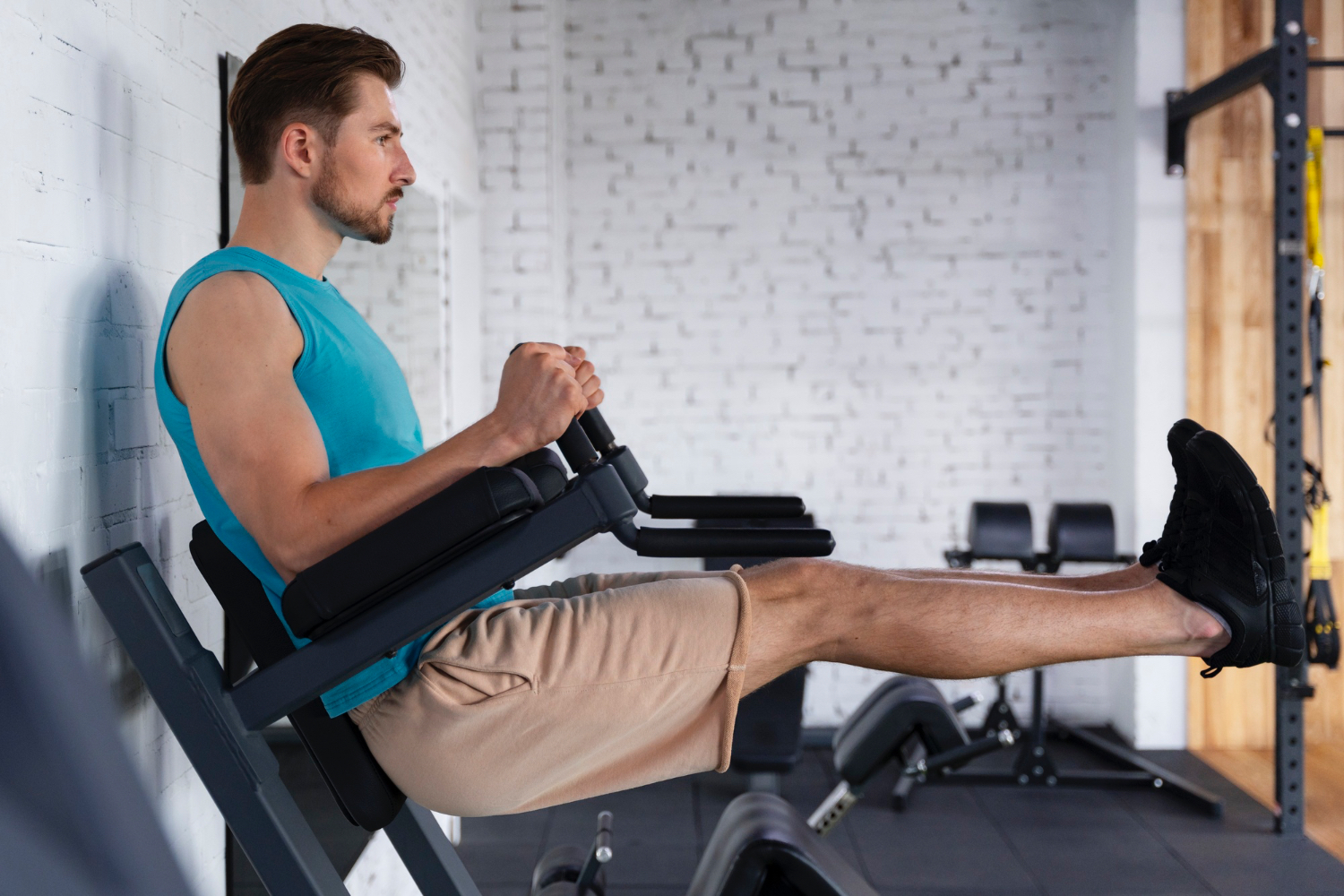
Beginner Progressions
Straight-leg hanging raises require considerable strength.
If you’re unable to perform them with good control, progress through the following stages.
Stage 1: Lying Leg Raises
Lie flat on the floor or bench.
Raise your legs while maintaining control and gradually build strength before progressing to hanging variations.
Stage 2: Assisted Knee Raise Machine
Many gyms have a captain’s chair or assisted leg raise station.
This removes the grip challenge and allows you to focus entirely on the abdominal contraction.
Stage 3: Bent-Knee Hanging Raises
Keep your knees bent throughout the movement while still focusing on rotating the pelvis upwards at the top.
Remember, progression is more important than ego.
Perfect technique with an easier variation will always produce better results than poor form on an advanced exercise.
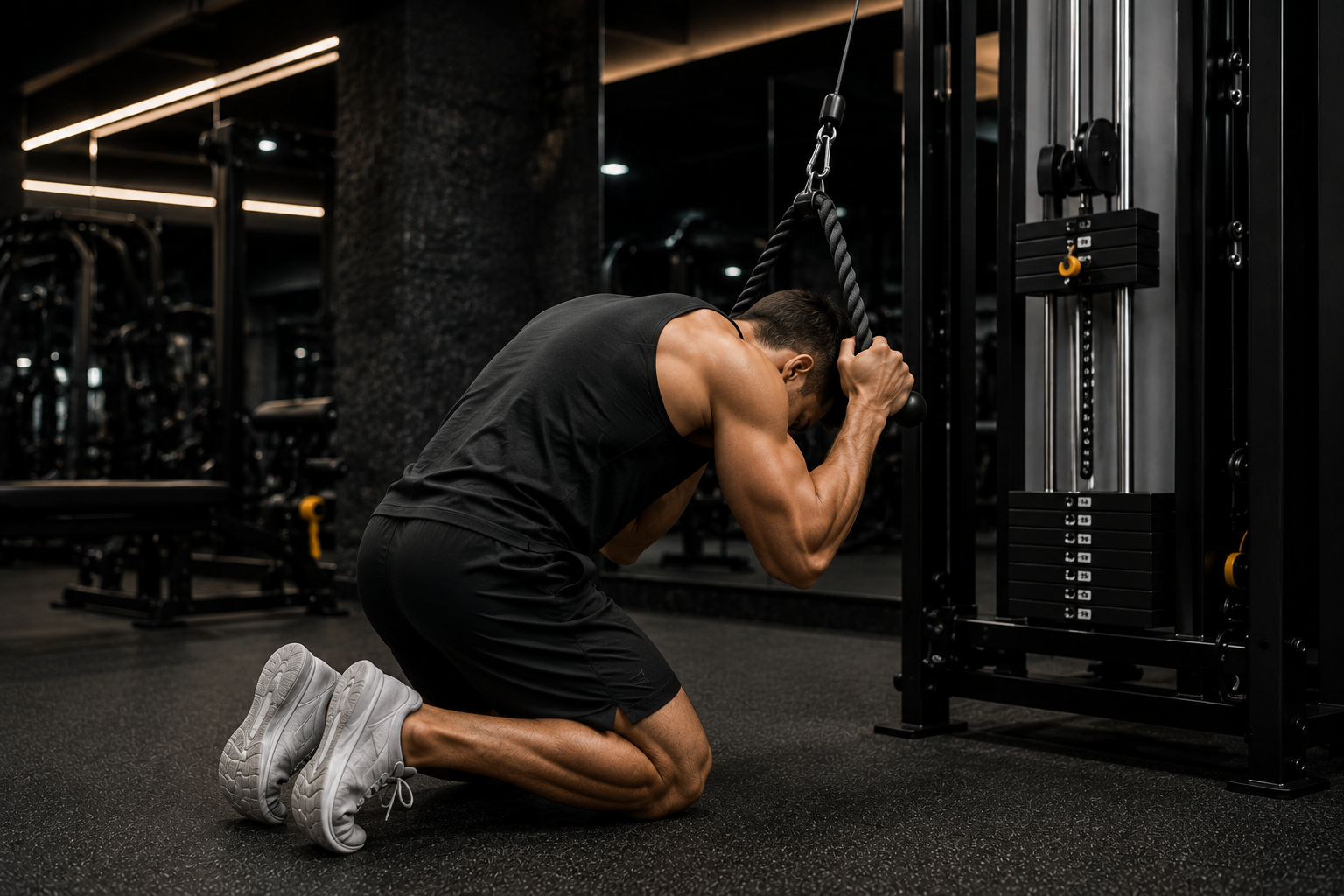
Exercise 2: Cable Crunches
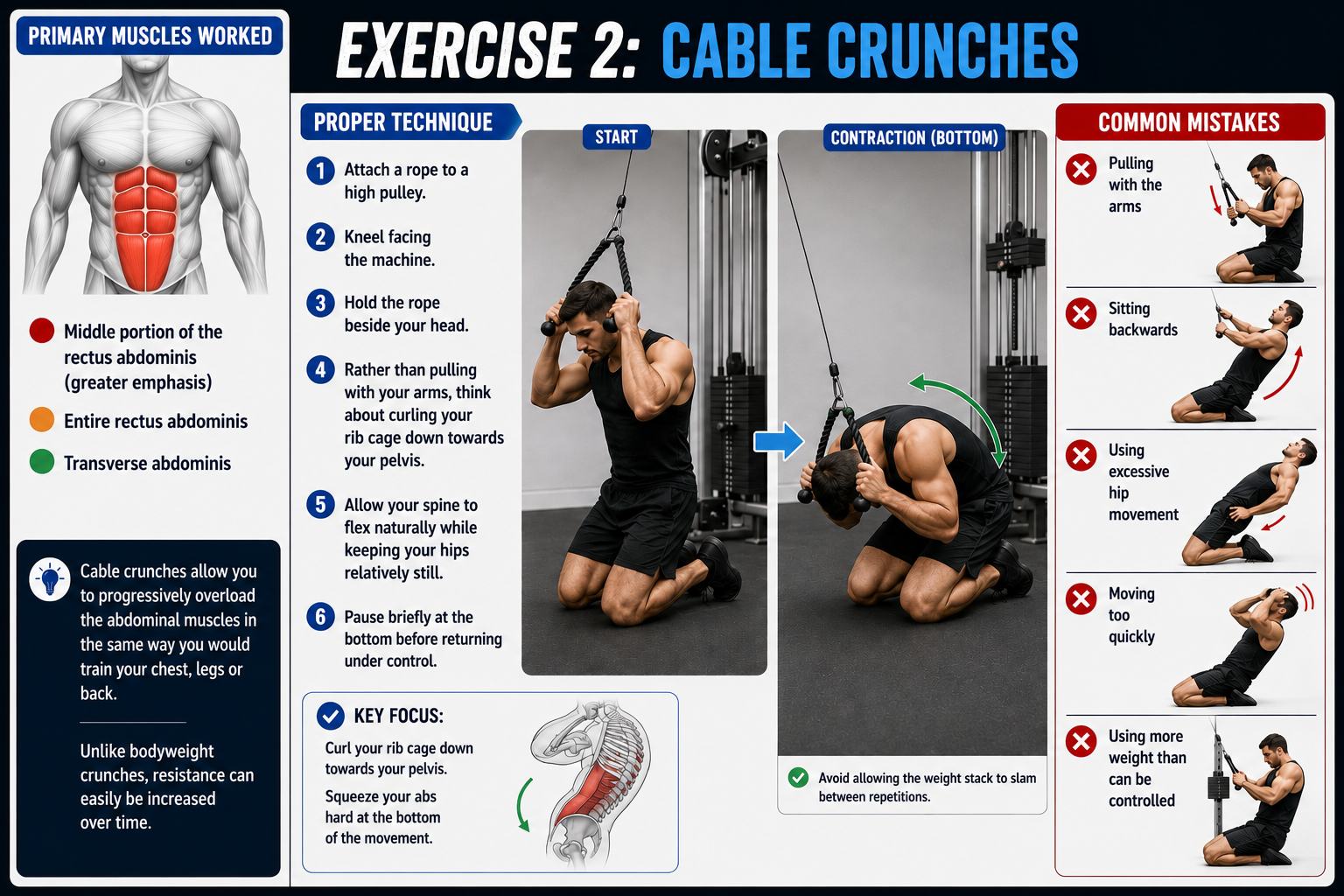
Primary Muscles Worked
- Middle portion of the rectus abdominis (greater emphasis)
- Entire rectus abdominis
- Transverse abdominis
Cable crunches allow you to progressively overload the abdominal muscles in the same way you would train your chest, legs or back.
Unlike bodyweight crunches, resistance can easily be increased over time.
Proper Technique
Attach a rope to a high pulley.
Kneel facing the machine.
Hold the rope beside your head.
Rather than pulling with your arms, think about curling your rib cage down towards your pelvis.
Allow your spine to flex naturally while keeping your hips relatively still.
Pause briefly at the bottom before returning under control.
Avoid allowing the weight stack to slam between repetitions.
Common Mistakes
- Pulling with the arms
- Sitting backwards
- Using excessive hip movement
- Moving too quickly
- Using more weight than can be controlled
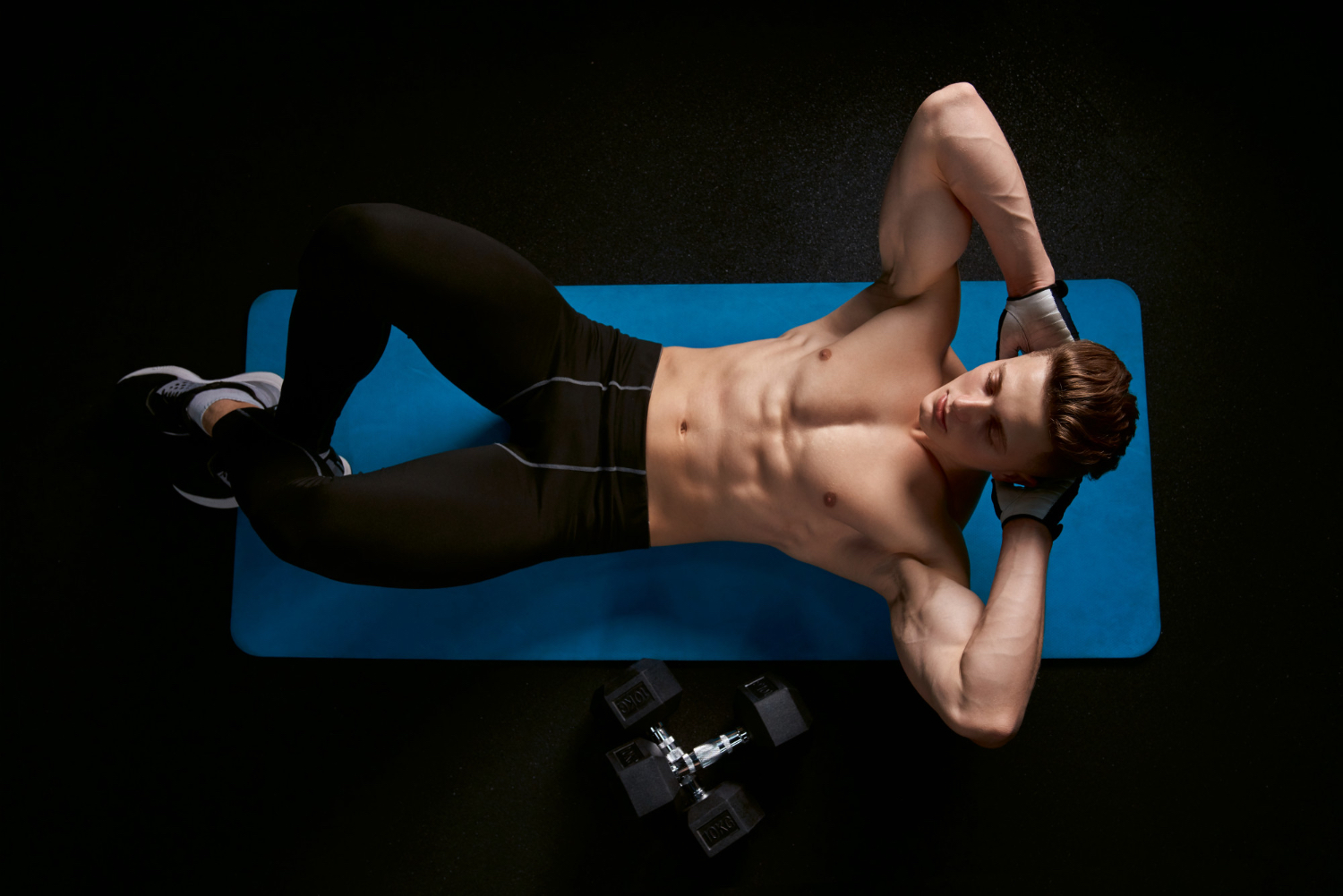
Exercise 3: Crunches
Primary Muscles Worked
- Upper portion of the rectus abdominis (greater emphasis)
Although crunches are one of the oldest abdominal exercises, they’re still highly effective when performed properly.
Because they’re performed after two demanding exercises, they’ll finish the workout by taking the abdominal muscles close to complete fatigue.
Proper Technique
Lie on your back with your knees bent.
Cross your arms over your chest or lightly place your fingertips beside your temples.
Curl your shoulders off the floor by contracting your abdominal muscles.
Focus on bringing your rib cage towards your pelvis rather than pulling your head forwards.
Lower slowly before repeating.
Train This Exercise to Failure
Unlike the previous two exercises, crunches can safely be performed to muscular failure.
Continue until you can no longer complete another repetition with good technique.
This provides an excellent finishing stimulus for the abdominal muscles.
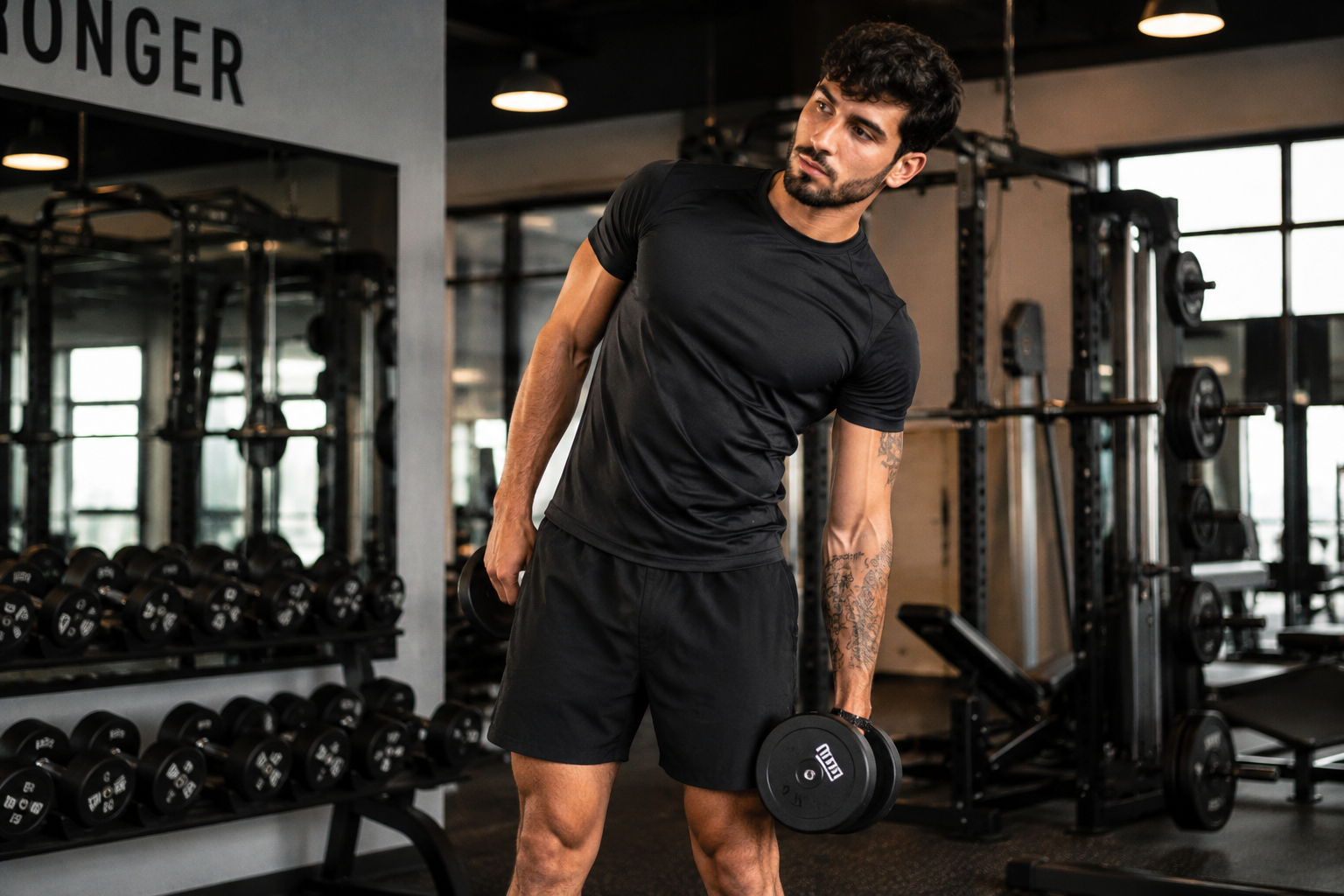
Optional Exercise 4: Weighted Side Bends
If you’d like additional oblique development, finish your workout with weighted side bends.
Muscles Worked
- External obliques
- Internal obliques
- Quadratus lumborum
- Core stabilisers
How to Perform Weighted Side Bends
This exercise can be performed using either:
- A low cable pulley with a single handle
- A dumbbell
- A weight plate
The key point is that the resistance should only be held in one hand.
Holding a weight in both hands balances the load and greatly reduces the challenge placed on the working oblique.
Stand upright holding the weight in one hand.
Slowly bend sideways towards the weighted side before returning to an upright position by contracting the opposite-side oblique.
Complete all repetitions before switching hands.
Common Mistakes
- Holding weight in both hands
- Twisting the torso
- Using momentum
- Leaning too far
Suggested Abs Workout Structure
| Exercise | Sets | Reps |
|---|---|---|
| Hanging Leg Raises | 3 | 8-12 |
| Cable Crunches | 3 | 10-15 |
| Crunches | 2-3 | To Failure |
| Weighted Side Bends (Optional) | 2-3 | 12-15 each side |
Rest Periods
Because these are isolation exercises, long rest periods aren’t necessary.
Recommended rest:
- 60-90 seconds between sets
- 90 seconds before changing exercises
The entire workout can usually be completed in around 15-20 minutes, or approximately 20-25 minutes if you include weighted side bends.
How Often Should You Train Abs?
Like any other muscle group, your abdominal muscles need time to recover.
For most people:
- 2-3 sessions per week
is sufficient.
Training abs every day isn’t necessary for muscle growth.
Recovery is just as important as the workout itself.
Can Ab Exercises Burn Belly Fat?
One of the biggest myths in fitness is the idea of “spot reduction”.
Unfortunately, you cannot choose where your body loses fat.
Performing thousands of crunches won’t specifically burn fat from your stomach.
Instead, body fat is lost across the entire body as you maintain a calorie deficit.
Genetics largely determine where fat is stored and where it comes off first.
Some people lose facial fat early.
Others lose fat from their arms or legs first.
For many people, abdominal fat is one of the last areas to become lean.
This is perfectly normal.
What Body Fat Percentage Is Needed for Visible Abs?
Visible abs depend on two factors:
- Well-developed abdominal muscles
- Low enough body-fat levels
For men, abdominal definition often begins to appear around:
- 12-15% body fat
A clearly defined six pack is commonly seen between:
- 8-12% body fat
For women, visible abdominal definition generally occurs at higher body-fat percentages due to natural physiological differences.
Typically:
- Around 18-22% body fat
It’s important to remember that these figures are only general guidelines.
Everyone stores body fat differently.
Nutrition Is Just as Important
If your goal is visible abs, your nutrition matters just as much as your training.
You could have strong, well-developed abdominal muscles, but if they’re covered by a layer of body fat they won’t be visible.
Creating a moderate calorie deficit through diet remains the most effective way to reduce body fat.
Prioritise:
- Lean protein
- Fruit and vegetables
- Whole grains
- Healthy fats
- Plenty of water
If you’d like to learn more about creating a calorie deficit and building a sustainable nutrition plan, see our guide on How to Create a Weight-Loss Plan.
Tips for Better Ab Training
To get the most from this workout:
- Focus on quality rather than quantity.
- Control every repetition.
- Avoid using momentum.
- Progressively increase resistance over time.
- Train through a full range of motion.
- Breathe out during the contraction.
- Avoid rushing between repetitions.
- Allow your core to recover between sessions.

Building Strong, Defined Abs
Developing a strong, well-defined core doesn’t require dozens of different exercises or lengthy ab circuits. A small number of well-chosen movements performed with good technique is often far more effective than completing endless repetitions with poor control.
By prioritising hanging leg raises, cable crunches and crunches—in that order—you’ll challenge the abdominal muscles through different movement patterns while ensuring the most demanding exercise is completed before fatigue sets in. If you wish to place additional emphasis on your obliques, weighted side bends provide an excellent finishing exercise when performed correctly.
Remember, visible abs are built through a combination of resistance training, progressive overload and reducing overall body fat. Stay consistent with both your training and nutrition, and over time your results will follow.
References
- Schoenfeld, B. J. (2010). The mechanisms of muscle hypertrophy and their application to resistance training.Journal of Strength and Conditioning Research.
- Escamilla, R. F., et al. (2010). Electromyographic analysis of traditional and non-traditional abdominal exercises.Journal of Orthopaedic & Sports Physical Therapy.
- American College of Sports Medicine. (2021). ACSM’s Guidelines for Exercise Testing and Prescription.
- Clark, D. R., Lambert, M. I., & Hunter, A. M. (2018). Muscle activation in abdominal exercises: A systematic review. Sports Medicine.